
Thank you to WFMZ for including me on a recent episode of Business Matters!

Thank you to WFMZ for including me on a recent episode of Business Matters!

| Mental illness is for the STRONG. No one without it can possibly know the courage it takes most days to get out of bed. You know who you are and you are not alone. Life is HARD, but we are STRONG. That’s all I have to say right now, but more will come later. One day at a time. |

I looked at the faces on my computer screen, the people in my support group with whom I’ve spent every Thursday night on Zoom for the past two years. As the facilitator, I try to stay positive, but one night I was really down. I had just gotten back from a girls’ weekend with two college friends, both of whom went on to have successful careers, one as a lawyer and the other as a high school principal.
I thought back to our college years and wondered what happened to me—the straight-A student who worked two part-time jobs, participated in choir, theatre, served as Philanthropy Chair in a sorority, and volunteered at a local school. I had looked forward to a bright future when all my hard work and dedication would pay off. And it did until a mental breakdown in my 40s upended my world.
Due to an unsupportive administration that exacerbated my mental health challenges, I had to give up my beloved career as a high school English and Drama teacher. As my college friends talked about juggling the demands of working full-time, raising children, and managing household tasks like cooking, cleaning, and paying bills, I felt like a failure. I can barely manage to work ten hours a week, my daughter is struggling with her own mental health issues, and my husband handles the majority of the household chores. I smiled and nodded, pretending to relate, but inside I felt broken and worthless.
As my support group shared how their week had gone, I debated whether or not to let them know how terrible I felt. As a leader, I didn’t want to take any focus off of them and I didn’t want to set a negative tone. But I needed to be honest. So I shared how difficult my weekend trip had been and how lonely and unaccomplished I felt.
Nicole, my fellow leader of the group, told me that she became a facilitator because I inspired her in one of the mental health courses I taught. She continued, “I know you feel like you’ve failed because you aren’t an English teacher anymore, but you are still teaching and impacting so many lives. More than you will ever know. So many people are here because of you.”
Another voice said, “I’m here because of you.”
Then another. “Me, too.”
My throat swelled and my heart filled with gratitude. A warm sensation spread throughout my body. I thanked them for their kind words and told them how much I needed to hear that.
Sometimes we can’t see what is right in front of us. Sometimes we get so caught up in what was supposed to be that we miss the beauty of what is. By pining for past employment or neglecting to explore other options, we rob ourselves of new and exciting opportunities and lasting, meaningful connections. We can still make a difference even if it’s not the way we had hoped or imagined. We can use our talents, skills, and experiences to enrich (even save) another’s life. I can’t think of anything more worthwhile than that. I may not have the money or the pension plan or the health insurance or the retirement benefits like I once did, but I have peace of mind and purpose and that is priceless.

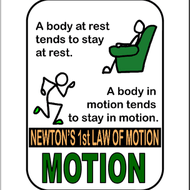
I’m no scientist and I don’t remember much about Physics, but I know all about inertia. It is easy for me to get stuck in a rut and I have to really push myself to get motivated. Some days are easier than others, but one thing’s for sure: lying on my couch doesn’t help. Once I get sucked into the couch vortex, I can disappear for hours. One hour leads to another and another. Before I know it, the day is almost over and I accomplished nothing. Then I think of all the things I should have done. Then I feel the guilt and shame and worthlessness. It’s a vicious cycle–the less I do, the worse I feel, and the more negative my thoughts become. So what does this have to do with Newton’s first Law of Motion? Everything.
In a game of dominoes, the dominoes remain still until one topples. When one moves, it causes the next to fall and so on. Bodies are no different. That’s why I need to make sure I get up and move during the day. It doesn’t need to be exercise or anything in particular, but if I don’t force myself to get up, I can easily stay there for a long time. Then the feeling and thoughts get going and soon I’m spiraling down a dark dark hole. However, if I can take one step no matter how small–topple one domino–it will often lead to the next one and I gain momentum.
The tricky part is that unless I have to be somewhere, I tend to stay put. Then I feel even worse for not doing anything when I had the time and the means. I swear working full-time is what kept me sane all those years. The great irony is that my mental illness prevents me from working full-time: I can’t handle the workload or the level of stress I took on before. It’s a constant challenge, but I try to catch it early and set myself in motion, often through the encouragement or accountability by a friend, peer, family member, therapist, etc. Many have told me that having a pet has saved their lives. Their pets give them purpose and force them to get up and walk them, feed them, play with them, and care for them. My pet, a sweet rescue cat named “Cinnamon,” prefers the couch so he isn’t much help in the get-up and get-moving department. He does give me joy, though. Thankfully, I have other things that keep me moving.
Finding ways to build in accountability and maintain a consistent routine can help so much. For me, volunteering and partial programs gave me that structure when I wasn’t able to provide it on my own. I had a specific time and place I needed to be. My therapy appointments and peer support group meetings helped me to get out, even if just for an hour or two. I learned to be gentle with myself and give myself credit for even the small tasks I completed. It feels good to cross something off a list, no matter how small it is. Accomplishing a goal builds momentum and moves energy in the right direction.
I still find myself drawn to the siren song of the couch, but it’s getting easier to steer away toward brighter shores. Sure, there are days I succumb and and crash, but I give myself grace, get back in my ship, and move on.

I don’t know how many times I’ve heard these responses to my depression. As if it’s that easy. Anyone who tells you “You’re just having a bad day. You’ll feel better in the morning” has clearly not experienced the crippling agony and utter devastation of depression.
Thankfully, there are programs in place that help family members understand and support their loved ones with mental illness. The Depression and Bipolar Support Alliance (DBSA) and The National Alliance on Mental Illness (NAMI) run programs and support groups for family members and friends.
The Lehigh Valley DBSA holds weekly support group meetings on Wednesdays at First Presbyterian Church on Tilghman St in Allentown from 7-9 pm. Contact information can be found by clicking here.
Another resource to help friends and family members understand mental illness and support their loved ones is NAMI’s Family-to-Family program, a free 12-session educational program taught by trained family members who have been there.
If friends and family members are not able to attend support meetings or participate in programs, there are plenty of websites to guide them. I referred my husband here.
As I was gathering material for this new blog site, I revisited an old blog I started 5 years ago. I wish I could have told my younger self not to worry so much and that it would all work out for the best. But then again, I needed to experience those lows to be able to fully appreciate where I’m at now. I needed to surround myself with people who would appreciate me and lift me up rather than undermine me and tear me down. While this site is dedicated toward helping others and advocacy, I started blogging five years ago to make sense of my life and the twists and turns it had taken. I wanted to form meaningful connections with others who struggled in similar ways. I longed to be authentic, but I worried people wouldn’t accept me. So I tried hard to be a person I was not and I felt even worse. You can find my old blog here: https://hidinginthespotlight.wordpress.com/
Now I am content with a smaller circle of friends and I put my time and energy into people who matter–people who will be there when the road is rough, people who aren’t just there when it’s convenient or they want something, people who I can be myself around.
When I was growing up, I remember my mom telling me I would be lucky to find just one true friend in life. At the time, I thought that was absurd and I figured she just wasn’t that popular or outgoing when she was my age. Besides, I had tons of friends. However, as I grew older, I learned the wisdom behind her words. I’m much happier being lifted up my a few loyal friends than surrounded by a group of people who will only end up bringing me down at a time when I need them most. Been there, done that. I respect myself too much now and I have come too far to play games and waste energy. After all, I only have so much energy these days and I need to invest it wisely. Lesson learned, mom.
I found the following tree analogy online, though I’m not sure who originated the idea of the “tree test.” Regardless, it resonates with me and I love it. Here it is:
WHAT KIND OF PERSON ARE YOU?
I have this tree analogy when I think of people in my life, be it friends, family, acquaintances, employees, co-workers, whomever…They are all placed inside what I call my tree test. It goes like this:
LEAF PEOPLE
Some people come into your life and they are like leaves on a tree. They are only there for a season. You can’t depend on them or count on them because they are weak and only there to give you shade. Like leaves, they are there to take what they need and as soon as it gets cold or a wind blows in your life they are gone. You can’t be angry at them, it’s just who they are.
BRANCH PEOPLE
There are some people who come into your life and they are like branches on a tree. They are stronger than leaves, but you have to be careful with them. They will stick around through most seasons, but if you go through a storm or two in your life it’s possible that you could lose them. Most times they break away when it’s tough. Although they are stronger than leaves, you have to test them out before you run out there and put all your weight on them. In most cases they can’t handle too much weight. But again, you can’t be mad with them, it’s just who they are.
ROOT PEOPLE
If you can find some people in your life who are like the roots of a tree then you have found something special. Like the roots of a tree, they are hard to find because they are not trying to be seen. Their only job is to hold you up and help you live a strong and healthy life. If you thrive, they are happy. They stay low key and don’t let the world know that they are there. And if you go through an awful storm they will hold you up. Their job is to hold you up, come what may, and to nourish you, feed you and water you.
Just as a tree has many limbs and many leaves, there are few roots. Look at your own life. How many leaves, branches and roots do you have? What are you in other people’s lives?
Hold On To Your Roots. Be the Root for Someone Else.
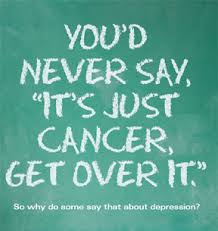
“Get over it.” This is one of the most frustrating responses I get during a bout of depression. Telling someone to “get over it” is like telling someone with broken legs to run a marathon. It defies common sense as depression affects the brain’s ability to think clearly in the first place. Others recommend going for a run or to the gym. If it were that simple, I would have already done that. I know that exercise helps with depression, but when just getting out of bed takes monumental effort, there isn’t much energy left for lacing up.
I don’t blame people who give this advice–in fact, I used to be one of them. I could never have realized the debilitating effects of depression until I experienced them firsthand. However, telling someone who is depressed to just “tough it out” or “snap out of it” points to a profound ignorance about mental health. No one would tell someone with cancer to just “deal with it” (nor should they), but depression is a life-threatening disease as well. Contrary to popular belief, depression is not just feeling tired or sad and upset over a recent loss. It is a serious life-long illness that requires treatment and while it can be managed with medication and lifestyle changes, there is no cure.
Sadly, there are many factors that prevent people from seeking help for a mental health condition. Perhaps the biggest deterrent is the stigma associated with mental illness. It seems mental illness only gets attention when some “crazy” person goes on a shooting rampage or a celebrity suffers a mental breakdown or commits suicide? This type of attention sensationalizes mental illness, instills fear, and attributes it to “the others”–often, the rich and famous or the truly criminal or deranged. It only perpetuates the stereotypes and misconceptions surrounding mental illness. Most mentally ill people do not commit crimes and should not be feared. Furthermore, mental illness affects people of all ages, races, genders, social classes, professions, etc. In fact, the National Institute of Health indicates that mental illness afflicts one in five American adults in any given year, and yet it remains a taboo and often misunderstood subject (2018).
Even though mental illness can be caused by environmental stresses, genetic factors, biochemical imbalances, or a combination, many view those with mental health conditions as “weak” or “lazy” or somehow at fault. Some of my own family members and friends have simply rolled their eyes at my pain and chalked it up to my being “dramatic” or “attention-seeking.” So, not only is someone with mental illness feared, he or she is further burdened with additional labels and made to feel “guilty,” “lazy,” or “ridiculous.” It is no surprise that so many people with mental illness feel rejected or ostracized, which only enhances isolation and feelings of worthlessness. When someone is seriously ill, people often rush to his or her aid delivering meals, sending flowers and cards, visiting them, and/or helping with household tasks or children. Cancer survivors are rightfully referred to as “warriors,” “survivors,” and “heroes.” But even though those with mental illness suffer, fight, and overcome tremendous battles as well, they are seldom honored and celebrated. Many survivors of serious health conditions say they could not have done it without the support of family, friends, colleagues, neighbors, yet many with mental illness find themselves with little support and few allies.
The shame and stigma with mental illness is so prevalent that some would rather suffer in silence (or even end their lives) than admit they have a mental disorder and seek help. Suicide is the 3rd leading cause of death in youths 10-24 and these rates are only rising (NAMI, 2018). Adolescents suffering from clinical depression increased by 37 percent between 2005 and 2014 (John Hopkins Health Review, 2017). Approximately 11 million U.S. adults aged 18 or older had at least one major depressive episode with severe impairment. (NIH, 2017). Clearly these statistics indicate a dire need for mental health intervention, yet there remains a significant deficit in providers and insurance coverage. Mental health programs continue to be cut or insufficiently funded. Research shows that nearly 60% of adults with a mental illness did not receive treatment (NAMI, 2018). With the lack of accessible treatment and the cost of comprehensive mental health care, on top of the stigma, it is not surprising that depression is the leading cause of disability worldwide (World Health Organization, 2017).
With limited access to care, those with mental illness often self-medicate with drugs and alcohol. In fact, 10.2 million adults have co-occuring mental health and addiction disorders (NAMI, 2018). Sadly, drugs and alcohol can be quicker and easier to obtain than an appointment with a therapist or psychiatrist. Furthermore, adding drugs and alcohol to mental illness compounds an already precarious situation. Mental illness can even be triggered by the use of drugs and alcohol. Like most illnesses, early intervention is key and yet little is being done with regards to mental illness other than sensational news coverage and punitive measures. There are valiant community efforts, support groups, dedicated volunteers, and a variety of helpful services and programs, but they are often limited in size and finances.
When will those with mental illness be treated with the dignity they deserve and not forced into silence and shame? When will mental health coverage and the number of providers and services meet the need? There is no simple solution, but each step, no matter how small, makes a difference. Each donation to mental health organizations such as the National Alliance on Mental Illness or the American Foundation for Suicide Prevention (AFSP), each time we speak out for those who cannot or lend a hand or call a friend, we are one step closer to change.
We never know who might be affected. It could be a family member you haven’t heard from in awhile, or a friend who suddenly stops coming to social events or a colleague who is out on a “medical leave.” It might be a child who smiles and seems to have it all, but self-harms behind closed doors. Now is the time to speak out, to share stories, to withhold judgment, to offer support, to seek treatment, to break down the wall of stigma before it takes the life of someone you know and love.

I describe myself as a “pessimist from birth.” Seriously, I can’t remember a time when I didn’t have worst case scenarios and “all or nothing” thinking. It’s as natural to me as breathing. I berated myself if I missed a point on a test. If I got a 99%, I focused on the 1% I got wrong. If I received a compliment, I discounted it and pointed out a mistake. I dwelled on negative feedback and experiences. After a break up, I replayed the saddest possible songs and reread letters, poured over pictures, wrote depressing poems, and wallowed in my despair. It was all I knew and, ironically, I took a sick comfort in the familiar; I knew how to handle failure, rejection, disappointment, dysfunction, chaos. Happiness, optimism, success–these were feelings I couldn’t understand. I didn’t know how to be comfortable with myself. It was as if by proclaiming my contentment or celebrating my success, I would somehow “jinx” myself. Some people avoid black cats or walking under ladders; my superstition was positive thinking.
As one of my favorite quotes states, “whether you think you can or you can’t, you’re right.” While I used to hold myself to ridiculously high standards and place myself in intensely stressful situations, I don’t have the energy for that anymore. Ever since my three year episode of debilitating depression, I have been gentler with myself. Sure, I still slip into old habits of self-deprecation and negativity, but I can’t allow myself to stay in that mindset long. I have to challenge and redirect my thoughts before I’m trapped in a cycle of negative thinking.
So how do I get myself out of this “stinking thinking?” I challenge my thoughts. When I think or feel a certain way, I ask myself “is this true?” “what evidence do I have?” “Is there another choice?” “how is this helping me?” Usually, I find that my thought is not rational or at least questionable. It gets me thinking of other ways to feel about something or another way to handle or feel about a difficult situation.
David Burns, renowned psychiatrist and author of Feeling Good, explains cognitive distortions and provides examples and charts to help reframe negative, irrational thoughts. The Pennsylvania Child Welfare Resource Center created the handout “Thinking About Thinking,” which is posted below:
These are 10 common cognitive distortions that can contribute to negative emotions. They also fuel catastrophic thinking patterns that are particularly disabling. Read these and see if you can identify ones that are familiar to you.
1. All-or-Nothing Thinking: You see things in black-or-white categories. If a situation falls short of perfect, you see it as a total failure. When a young woman on a diet ate a spoonful of ice cream, she told herself, “I’ve blown my diet completely.” This thought upset her so much that she gobbled down an entire quart of ice cream!
2. Over generalization: You see a single negative event, such as a romantic rejection or a career reversal, as a never-ending pattern of defeat by using words such as “always” or “never” when you think about it. A depressed salesman became terribly upset when he noticed bird dung on the windshield of his car. He told himself, “Just my luck! Birds are always crapping on my car!”
3. Mental Filter: You pick out a single negative detail and dwell on it exclusively, so that your vision of all reality becomes darkened, like the drop of ink that discolors a beaker of water. Example: You receive many positive comments about your presentation to a group of associates at work, but one of them says something mildly critical. You obsess about his reaction for days and ignore all the positive feedback.
4. Discounting the Positive: You reject positive experiences by insisting they “don’t count.” If you do a good job, you may tell yourself that it wasn’t good enough or that anyone could have done as well. Discounting the positive takes the joy out of life and makes you feel inadequate and unrewarded.
5. Jumping to Conclusions: You interpret things negatively when there are no facts to support your conclusion. Mind Reading: Without checking it out, you arbitrarily conclude that someone is reacting negatively to you. Fortune-telling: You predict that things will turn out badly. Before a test you may tell yourself, “I’m really going to blow it. What if I flunk?” If you’re depressed you may tell yourself, “I’ll never get better.”
6. Magnification: You exaggerate the importance of your problems and shortcomings, or you minimize the importance of your desirable qualities. This is also called the “binocular trick.”
7. Emotional Reasoning: You assume that your negative emotions necessarily reflect the way things really are: “I feel terrified about going on airplanes. It must be very dangerous to fly.” Or “I feel guilty. I must be a rotten person.” Or “I feel angry. This proves I’m being treated unfairly.” Or “I feel so inferior. This means I’m a second-rate person.” Or “I feel hopeless. I must really be hopeless.”
8. “Should statements”: You tell yourself that things should be the way you hoped or expected them to be. After playing a difficult piece on the piano, a gifted pianist told herself, “I shouldn’t have made so many mistakes.” This made her feel so disgusted that she quit practicing for several days. “Musts,” “oughts” and “have tos” are similar offenders. “Should statements” that are directed against yourself lead to guilt and frustration. Should statements that are directed against other people or the world in general lead to anger and frustration: “He shouldn’t be so stubborn and argumentative.” Many people try to motivate themselves with should and shouldn’ts, as if they were delinquents who had to be punished before they could be expected to do anything. “I shouldn’t eat that doughnut.” This usually doesn’t work because all these should and musts make you feel rebellious and you get the urge to do just the opposite. Dr. Albert Ellis has called this “musterbation.” I call it the “shouldy” approach to life.
9. Labeling: Labeling is an extreme form of all-or-nothing thinking. Instead of saying “I made a mistake,” you attach a negative label to yourself: “I’m a loser.” You might also label yourself “a fool” or “a failure” or “a jerk.” Labeling is quite irrational because you are not the same as what you do. Human beings exist, but “fools,” “losers,” and “jerks” do not. These labels are just useless abstractions that lead to anger, anxiety, frustration, and low self-esteem. You may also label others. When someone does something that rubs you the wrong way, you may tell yourself: “He’s an S.O.B.” Then you feel that the problem is with that person’s “character” or “essence” instead of with their thinking or behavior. You see them as totally bad. This makes you feel hostile and hopeless about improving things and leaves little room for constructive communication.
10. Personalization and blame: Personalization occurs when you hold yourself personally responsible for an event that isn’t entirely under your control. When a woman received a note that her child was having difficulties at school, she told herself, “This shows what a bad mother I am,” instead of trying to pinpoint the cause of the problem so that she could be helpful to her child. When another woman’s husband beat her, she told herself, “If only I were better in bed, he wouldn’t beat me.” Personalization leads to guilt, shame, and feelings of inadequacy.
Some people do the opposite. They blame other people or their circumstances for their problems, and they overlook ways that they might be contributing to the problem: “The reason my marriage is so lousy is because my spouse is totally unreasonable.” Blame usually doesn’t work very well because other people will resent being scapegoated and they will just toss the blame right back in your lap. It’s like the game of hot potato – no one wants to get stuck with it.
Reframing Tips:
Explore what’s stressing you: View your situation with positive eyes.
Find what you can change: If you could, what parts of your situation would you most like to change? With positive reframing, you may see possibilities you weren’t aware of before.
Identify benefits: Find the benefits in the situation you face.
Discover the humor: Find the aspects of your situation that you face.
Discover the humor: Find the aspects of your situation that are so absurd you can’t help but laugh
References
Burns David, M.D. The Feeling Good Handbook. Harper-Collins Publishers: New York, 1989.
“Thinking About Thinking.” The Pennsylvania Child Welfare Resource Center 313: Managing the Impact of Traumatic Stress on the Child Welfare Professional Handout #15.

I wasn’t going to go to my weekly DBSA meeting. I was tired, it was dark, and I had a long day. In fact, I’ve been stuck in a rut for the past two weeks–nothing severe, just low motivation and returning to old poor habits. But something pushed me, I got myself out the door, and I drove to the church where my peer support group meets every Wed.
I shared my struggle with motivation and the general heaviness I’ve been feeling lately with the rest of the group. As usual, I got helpful supportive suggestions from people who also struggle with anxiety and depression (e.g., making daily lists of small tasks, embedding a reward system, focusing on one goal at a time, being gentle with myself).
As the meeting progressed, I found myself becoming gradually more interested and invested in others’ stories and even offering feedback and encouragement. One thing is certain: it is very difficult to feel down when you are helping someone else. There is also comfort in feeling like you are not alone and no one is judging you. Participating in peer groups also takes me out of my own head and my own self-doubt and worries. In fact, peer support group is one of my strongest allies in fighting this disease and keeping my depression at bay. These people get me. Or as Sally Fields would say, “they like me. They really like me!”
And if that isn’t enough of a reason to drag myself off the couch, this last part is. After the meeting, a young man (19 years old) came up to me and told me that he remembered me from when I spoke at the hospital when he was hospitalized in September. He thanked me and told me my story inspired him and I was the reason he was there.
He will never know how much his words mean to me and how much I needed to hear them. A huge smile spread across my face and I swear I floated out that door.
 Christina L. Dunbar