
Thank you to WFMZ for including me on a recent episode of Business Matters!

Thank you to WFMZ for including me on a recent episode of Business Matters!

https://drive.google.com/file/d/1Fh5vB7bD0OS1gCrXF8kcJxtIcbvp3AM1/view?usp=sharing
| In 2019, I attended an IWWG Conference that didn’t end so well. The excitement and creative energy in addition to commuting back and forth for six days, enrolling in two intensive workshops, attending every breakout session, and tackling traumatic subject matter spiraled me into mania. I had to leave the conference early, missing the culminating activities, including performances of my classmates’ scenes for which I’d been asked to perform in and had rehearsed all week. As a professional mental health peer advocate, I was mortified by my erratic behavior and relapse. Even worse, I felt tremendous guilt about missing the opportunity to perform in my classmates’ pieces. I swore I’d never show my face again at another IWWG Conference. Last year, I mustered the courage to attend the annual IWWG conference since it was only an hour away and my writing buddy would also be attending. This time I was determined to finish the conference with my dignity (and sanity) intact. I vowed to pace myself, practice self-care, avoid alcohol, and get plenty of sleep. I packed my bags and hoped no one would remember me. As soon as I arrived, I recognized many names and faces from that dreaded conference. I’d noticed others looking at me, probably wondering if I was that same poor girl whose husband came to retrieve her in her frenzied state several years ago. Embarrassment and shame burned through me, but I pushed those feelings aside and carried on. I maintained a low profile for the rest of the week and resisted any of the night time events. However, I’d written a piece that I wanted to share at an open mic night so I signed up and prepared for my reading. As I was revising my piece, a voice kept niggling in my brain—Why am I here? Impostor syndrome set in. Who will even care about what I have to say, especially since they likely think I’m crazy? The shame of stigma paralyzed me. I’d never be able to redeem myself among these esteemed writers with years of conferences and accolades under their belts. Still, I felt this pressing need to speak. Then it hit me— Maybe I could use this open mic as an opportunity to not only acknowledge my mental illness but to illustrate what recovery looks like. Recovery looks like me. I recalled all I’d learned since that first episode twelve years ago. I reminded myself that even though I had a setback, I’d rebounded and returned wiser and stronger. Isn’t that what recovery is all about? As a proud peer advocate, I like to be open and transparent about my own mental health struggles. Since there’s no cure for mental illness, relapses are bound to happen. I decided to use the open mic as an opportunity to inform others about mental health and to reclaim my voice and dignity among the very people with whom I’d lost it several years ago, After all, life is not about how far you fall, but how many times you get back up. This speech is the result. I have to admit I’m proud of my transparency and courage. |
I’m so honored to have been featured in NAMI’s End of the Year appeal. I hope that my story will inspire others in their own mental health journeys. Mental illness is a manageable illness and there is hope no matter how hopeless you feel. Hopelessness is a persuasive and dangerous symptom of depression; it convinces you that there is no hope when there is always hope! Hope for a new medication or treatment, hope with new and effective coping strategies, hope with knowledge and support, hope for future wellness! Check out my feature at the link below

Every time I speak to peers in inpatient and outpatient settings, I share this Cherokee legend with them. The tale illustrates the battle between good thoughts and bad thoughts and the importance of feeding the “good wolf.”
ONE EVENING, AN OLD
CHEROKEE MAN TOLD HIS
GRANDSON ABOUT A BATTLE THAT
GOES ON INSIDE PEOPLE.
HE SAID “MY SON, THE BATTLE IS
BETWEEN TWO ‘WOLVES’ INSIDE US ALL.
ONE IS EVIL. IT IS ANGER,
ENVY, JEALOUSY, SORROW,
REGRET, GREED, ARROGANCE,
SELF-PITY, GUILT, RESENTMENT,
INFERIORITY, LIES, FALSE PRIDE,
SUPERIORITY, AND EGO.
THE OTHER IS GOOD.
IT IS JOY, PEACE LOVE, HOPE, SERENITY,
HUMILITY, KINDNESS, BENEVOLENCE,
EMPATHY, GENEROSITY,
TRUTH, COMPASSION, AND FAITH.”
THE GRANDSON THOUGHT ABOUT
IT FOR A MINUTE AND THEN ASKED
HIS GRANDFATHER:
“WHICH WOLF WINS?…”
THE OLD CHEROKEE SIMPLY REPLIED,
“THE ONE THAT YOU FEED.”

Father’s Day brings up so many difficult feelings. While others are out celebrating their dads or honoring their memory, I have to build up the courage to make a phone call. Growing up, my dad and I had always been close. Despite my parents getting divorced when I was in third grade, I still saw him every weekend and I looked forward to our time together at his apartment a half hour away. We’d pop popcorn and watch movies on HBO. We’d go to his office and do “work.” He’d pay me to write out the envelopes for prospective clients. We’d go grocery shopping and out to eat. He’d take my friends and me to the mall and host sleepovers with my friends. We’d go to the laundromat every Sunday and race washing machines. We’d put the quarters in the slots and push them in to the machine when my dad said “Go.” We’d play games in the car like “Name That Tune.” He’d whistle a few notes of a popular song and I’d try to guess what it was. When I was in high school, we’d go to a local bar/restaurant for Karaoke nights. He’d even buy me my favorite drink—a fuzzy navel! I sang with the owner so he bent the rules a bit.
Anyway, my dad was my hero. He never missed a performance and there were a lot. He would even go to the same musical multiple times and sit in different areas for different perspectives. Every bank teller knew every accomplishment of mine and told me how proud my dad was of me every time I went to the bank with him. He was dynamic and creative and fun. He was also bipolar, though he was never diagnosed or medicated for the illness. This created lots of unnecessary stress and dysfunction in our already non-traditional family. He’d go from jokes and laughter to rage in a split second and the smallest thing could set him off. Actually, he handled the larger issues with far more calmness and grace. But a dish out of place or a dribble of milk on the counter and you could hear him for miles.
Our relationship became more complicated when I started living with him during my sophomore year of high school. He had an unstable girlfriend who moved in with us and faked a pregnancy and miscarriage (despite a full hysterectomy years before), and then cancer. She’d leave clumps of her hair around as proof, though she was really just pulling her hair out to suit her sordid narrative. For fun, she would take out her false teeth, pull her hair back from her forehead, stick out her tongue, and chase me around the house when my dad wasn’t around. She howled when they had sex and even told me that my dad prefers blowjobs with her teeth out. Ugh. Not information that a teenager needs to learn about her father. Anyway….
When we moved to a new house my senior year of high school, I co-signed under the impression that if something happened to him, I would still have a place to live. Now that I’m older, I know that unless a house is paid off, the bank will come to the co-signer for the mortgage payment. As a recent college graduate responsible for my own rent, I didn’t have the money for an additional mortgage payment so the house foreclosed. I also learned that my dad had taken several credit cards out in my name without my knowledge. To make financial matters worse, my dad’s name was on my checking and savings accounts so my accounts were frozen and I had no access to my money. Then my dad was arrested for insurance fraud and put behind bars for several years. Unable to pay off all the debt from my father, I had to declare bankruptcy at 22 without having charged a cent. Not an ideal start to life on my own. For the next seven years, I learned to live with little money and no credit.
Five years later, he got out of prison, but he wasn’t the same fun and supportive dad. He was hard and cynical. He made promises he never kept. I caught him in more lies than I can remember and he never owned up to ripping off all his clients. He also never apologized for all he’d put me through as a young adult.
Flash forward to the present. My dad, who was diagnosed with Alzheimer’s last year, is staying in an assisted-living facility an hour and a half away. I call him, but he rarely answers. I visit him from time to time and take him out for dinner and grocery shopping. He’s always appreciative and happy to see me, but the visits take a toll on my mental health. He seems to have forgotten all the hell he’s put me through and only remembers all the good things he’s done. Probably a defense mechanism so he can live easier with himself. I accept that and just want him to enjoy the years he has left. He’s lonely, though much of that is his fault. That’s punishment enough. I don’t need to make it worse for him. But that doesn’t mean it isn’t hard and I don’t struggle. Not just on Father’s Day, but every day.

I looked at the faces on my computer screen, the people in my support group with whom I’ve spent every Thursday night on Zoom for the past two years. As the facilitator, I try to stay positive, but one night I was really down. I had just gotten back from a girls’ weekend with two college friends, both of whom went on to have successful careers, one as a lawyer and the other as a high school principal.
I thought back to our college years and wondered what happened to me—the straight-A student who worked two part-time jobs, participated in choir, theatre, served as Philanthropy Chair in a sorority, and volunteered at a local school. I had looked forward to a bright future when all my hard work and dedication would pay off. And it did until a mental breakdown in my 40s upended my world.
Due to an unsupportive administration that exacerbated my mental health challenges, I had to give up my beloved career as a high school English and Drama teacher. As my college friends talked about juggling the demands of working full-time, raising children, and managing household tasks like cooking, cleaning, and paying bills, I felt like a failure. I can barely manage to work ten hours a week, my daughter is struggling with her own mental health issues, and my husband handles the majority of the household chores. I smiled and nodded, pretending to relate, but inside I felt broken and worthless.
As my support group shared how their week had gone, I debated whether or not to let them know how terrible I felt. As a leader, I didn’t want to take any focus off of them and I didn’t want to set a negative tone. But I needed to be honest. So I shared how difficult my weekend trip had been and how lonely and unaccomplished I felt.
Nicole, my fellow leader of the group, told me that she became a facilitator because I inspired her in one of the mental health courses I taught. She continued, “I know you feel like you’ve failed because you aren’t an English teacher anymore, but you are still teaching and impacting so many lives. More than you will ever know. So many people are here because of you.”
Another voice said, “I’m here because of you.”
Then another. “Me, too.”
My throat swelled and my heart filled with gratitude. A warm sensation spread throughout my body. I thanked them for their kind words and told them how much I needed to hear that.
Sometimes we can’t see what is right in front of us. Sometimes we get so caught up in what was supposed to be that we miss the beauty of what is. By pining for past employment or neglecting to explore other options, we rob ourselves of new and exciting opportunities and lasting, meaningful connections. We can still make a difference even if it’s not the way we had hoped or imagined. We can use our talents, skills, and experiences to enrich (even save) another’s life. I can’t think of anything more worthwhile than that. I may not have the money or the pension plan or the health insurance or the retirement benefits like I once did, but I have peace of mind and purpose and that is priceless.
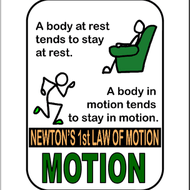
I’m no scientist and I don’t remember much about Physics, but I know all about inertia. It is easy for me to get stuck in a rut and I have to really push myself to get motivated. Some days are easier than others, but one thing’s for sure: lying on my couch doesn’t help. Once I get sucked into the couch vortex, I can disappear for hours. One hour leads to another and another. Before I know it, the day is almost over and I accomplished nothing. Then I think of all the things I should have done. Then I feel the guilt and shame and worthlessness. It’s a vicious cycle–the less I do, the worse I feel, and the more negative my thoughts become. So what does this have to do with Newton’s first Law of Motion? Everything.
In a game of dominoes, the dominoes remain still until one topples. When one moves, it causes the next to fall and so on. Bodies are no different. That’s why I need to make sure I get up and move during the day. It doesn’t need to be exercise or anything in particular, but if I don’t force myself to get up, I can easily stay there for a long time. Then the feeling and thoughts get going and soon I’m spiraling down a dark dark hole. However, if I can take one step no matter how small–topple one domino–it will often lead to the next one and I gain momentum.
The tricky part is that unless I have to be somewhere, I tend to stay put. Then I feel even worse for not doing anything when I had the time and the means. I swear working full-time is what kept me sane all those years. The great irony is that my mental illness prevents me from working full-time: I can’t handle the workload or the level of stress I took on before. It’s a constant challenge, but I try to catch it early and set myself in motion, often through the encouragement or accountability by a friend, peer, family member, therapist, etc. Many have told me that having a pet has saved their lives. Their pets give them purpose and force them to get up and walk them, feed them, play with them, and care for them. My pet, a sweet rescue cat named “Cinnamon,” prefers the couch so he isn’t much help in the get-up and get-moving department. He does give me joy, though. Thankfully, I have other things that keep me moving.
Finding ways to build in accountability and maintain a consistent routine can help so much. For me, volunteering and partial programs gave me that structure when I wasn’t able to provide it on my own. I had a specific time and place I needed to be. My therapy appointments and peer support group meetings helped me to get out, even if just for an hour or two. I learned to be gentle with myself and give myself credit for even the small tasks I completed. It feels good to cross something off a list, no matter how small it is. Accomplishing a goal builds momentum and moves energy in the right direction.
I still find myself drawn to the siren song of the couch, but it’s getting easier to steer away toward brighter shores. Sure, there are days I succumb and and crash, but I give myself grace, get back in my ship, and move on.

I don’t know how many times I’ve heard these responses to my depression. As if it’s that easy. Anyone who tells you “You’re just having a bad day. You’ll feel better in the morning” has clearly not experienced the crippling agony and utter devastation of depression.
Thankfully, there are programs in place that help family members understand and support their loved ones with mental illness. The Depression and Bipolar Support Alliance (DBSA) and The National Alliance on Mental Illness (NAMI) run programs and support groups for family members and friends.
The Lehigh Valley DBSA holds weekly support group meetings on Wednesdays at First Presbyterian Church on Tilghman St in Allentown from 7-9 pm. Contact information can be found by clicking here.
Another resource to help friends and family members understand mental illness and support their loved ones is NAMI’s Family-to-Family program, a free 12-session educational program taught by trained family members who have been there.
If friends and family members are not able to attend support meetings or participate in programs, there are plenty of websites to guide them. I referred my husband here.

One of the hardest things I’ve ever had to do is resign from my job as a high school English and Theatre Arts teacher. From the time I lined up my stuffed animals on the basement stairs and taught them their ABCs, I had always wanted to be a teacher. After many years of hard work and sacrifice, I had achieved my Master’s in Education, reached the top of the pay scale, and possessed a retirement plan that seemed to be the envy of all. With tenure, seniority, and the support of a powerful and vocal union, I felt safe and secure. I loved being a teacher and devoted much (in retrospect, too much) of my time and energy there.
Then supportive and empowering administrators were replaced with critical and punitive ones. Teachers were forced to administer daily prescribed curriculum and threatened with insubordination for asking legitimate questions. District office personnel we had never even seen started penetrating the building, in search of anyone in violation. Esteemed teachers started leaving at alarming rates for new jobs, early retirements. Soon the toxic environment pushed me to my breaking point as well. In one day, I went from teaching in my classroom to being admitted to a hospital psychiatric unit. There’s nothing funny about that. But hold on.
I spent the next year and a half out on medical leave and worked on my recovery. As my brain healed and my confidence returned, the time came when I had to either return or resign. Devastated, but not wanting to risk a relapse, I waited until the very last day and resigned from teaching–the career I treasured and worked so hard to achieve. Still not funny, but wait–there’s more!
It took me YEARS to get over it and I harbored resentment until it ate me from the inside like a radioactive element. I had no idea how to channel all that pain, anger, and bitterness. Until one day, I just started laughing about how ridiculous my situation had become. I realized the absurdity and futility of remaining in the profession I once cherished and prided myself on my courage to leave. As if in a trance, I opened a Word document and my fingers found the keys and within ten minutes, I had written this short scene, which is based on an actual conversation I had with an administrator. I changed the end to reflect what most teachers who find themselves in this situation want to say, but can’t (that is, if they want to stay employed). So whenever I feel myself pining for the job I left behind or those angry, bitter feelings start to swell, I pull out this piece and chuckle anew.
So without further ado, I give to you BANG HEAD HERE:
PRINCIPAL, a 30-year-old male in tan dress pants and a light blue button-down collared shirt under a gray sports jacket sits at a large mahogany desk in his office leisurely scrolling through e-mail with a warm cup of coffee resting on upper right side of desk. TEACHER, a neatly dressed woman in her mid to late 40s, stands outside his office, anxiously waiting for PRINCIPAL’S attention and glancing at her watch. TEACHER wipes sweat from forehead and clears throat to get his attention.
P (looks up, but quickly resumes typing): I’ll be right with you. I’m just finishing up an e-mail.
T (glances again at watch uneasily, clearly annoyed): I can see you’re busy, but our appointment is scheduled for—
P (Still focused on screen, waving T into his air-conditioned office and continues to type): Oh, yes. Please have a seat. I’ll be right with you. (He grins and chuckles to himself, as if he’s crafted a witty post or created a new meme).
T: (Sitting in chair): I have to teach in ten minutes.
After a final emphatic click and a self-assured nod.
P: (Sighing and leaning back in leather high-backed swivel chair and folding hands behind his head). So, what brings you here?
T: As I mentioned in my e-mail, I wanted to address some concerns I have related to Anthony’s ongoing behavior in my class.
P: Oh yes, that’s right. Neat kid. (Nods head agreeably, though he has no clue who Anthony is). So, what seems to be the problem? (P leans forward to sip some coffee.)
T: (Matter of fact): Tony disrupts class on a daily basis and it’s making it difficult for the other students to learn.
P: Hmmm, I see. (He takes another sip and replaces cup, folds hands on desk.) So, what is he doing to disrupt the other students?
T: Well, yesterday he just got out of his seat and took another student’s pencil. Then he—
P (Cutting teacher off. Defensively.) Perhaps he needed one.
T: I don’t think so.
P: How do you know that?
T: He threw it out the window.
P: Wait. Why was he near the window?
T (Confused by question): Why was he—?
P: Yes, why was he by the window in the first place?
T: His case manager recommended Tony be able to get up and move as he feels the need. It’s part of his IEP. The point is he took another student’s pencil and—
P: Yes, I understand that. But why would he go to the window?
T: Probably to throw out the student’s pencil.
P: Why were the windows open?
T: It’s over 90 degrees today and there’s no air-conditioning in my room. It gets very hot in a small room with 30 students and it helps to–
P: In the future, just have him sit on the other side of the room so he isn’t near the window.
T (frustrated): He doesn’t sit near a window. He got out of his seat and walked over to the window. That’s when he grabbed a student’s pencil and tossed it—
P (Appears to be in thought) Now, I’m not suggesting…. Well, I’m wondering if…. Well, exactly what were the other students doing when Tommy got out of his seat?
T: Tony.
P: What? Oh, Tony. Yes, Tony.
T: They were writing in their journals.
P (Disapprovingly, turning mouth down): That’s a rather sedentary activity.
T: Well, it’s a five-minute freewriting exercise to get their ideas flowing and to generate material for their writing. It also helps with fluency.
P: (Confused): Fluency? (Beat.) Could this activity be more interactive?
T: After they write, they share what they’ve written with a peer. It’s just a warm up to get them—
P (Shakes head in confusion): A warm-up?
T: Yes, to get them thinking, writing, putting their thoughts—
P: Yes, but what do they DO with these thoughts?
T: It’s a prewriting activity for the first stage of the writing process. Eventually, their responses become—
P: Yes, but—
T: the basis for a thesis or a narrative or a poem.
P: But clearly, this is not an activity that engages ALL students so consider other ways for students to express their ideas. Otherwise, Tommy will continue to be disengaged and act out. I would suggest reaching out to other teachers for ideas on how to create more engaging lessons.
T: This was just a five-minute—
P: Well, let’s get back to Johnny. I mean, Tommy. How did you respond when he threw the pencil out of the window?
T: I gave the student another pencil so she could continue writing, but at that point, most of the students were reacting to Tony so I asked him to step out into the hall so I could speak to him privately, but he yelled “Fuck that! I’m going to the library!” and stormed out of the room.
P: So you just let him go? That sounds like you’re rewarding him.
T: Well, I couldn’t continue to follow him down the hall and leave the other 29 students unsupervised. I did call the library and they confirmed he was there.
P: Why didn’t you send him to his case manager?
T: She is co-teaching a class that period so she isn’t available. There is another case manager Tony can go to, but he refuses.
P: Have you talked to his case manager about this?
T (checks watch, starts to panic): Not face-to-face. I did send several e-mails to her as well as his guidance counselor explaining the ongoing situation, but I haven’t heard back yet. I’ve also spoken to his mom about his behavior.
P: And what did she say?
T: She said she gave up years ago and wished me luck.
(A brief pause ensues.)
P: You mentioned ongoing behavior? What other things has Tim done?
T: He calls out random things in the middle of class to get attention.
P (smiles and leans back in chair): Ah, so he’s comfortable speaking out in class. Perhaps you could find positive ways for him to use his voice and sense of humor?
T (shocked and confused): Sense of–??
P: He obviously wants to participate. Perhaps you could let him teach a lesson or assist in some other constructive way?
T: I tried that and it was a disaster. He ended up making faces at his classmates and telling jokes. I’d love to get him involved that way, but he would still need to follow the expectations, stay focused–
P: I’m sure he will once you give him some leadership. He hasn’t had problems in his other classes. Have you talked to them about what they’re doing?
T: Actually, I emailed all of his teachers this semester. Only two responded and they both said he acts the same way in their classes.
P: I must say, I’m surprised. We’ve never had any problems with Tim in the past.
T: Tony was expelled last year and spent the rest of the school year in alternative school.
P: I mean, this year.
T: (Checks watch.) Well, I have a class in one minute so –
P: Oh, have you met the Special Ed Lead Teacher? He’s a great resource, too.
T: Yes, we co-taught a class last year. (Rises to leave.)
P: I’m really glad we could figure this out.
T: Oh, I figured it out. You want me to waste taxpayers’ money and deny 29 other students their right to an education so I can escort a special needs student to the library because his case manager is co-teaching a class and isn’t even available as a resource, which is in clear violation of his IEP.
P: (Confused.)Wait. What???
Bell rings.
T: We can continue this conversation in my room after school. I’m in A125.
P is still processing, not sure what just happened.
T: (Turns back right before she enters the sweltering heat of the hallway.) Oh, and you might want to ditch the sports jacket. It’s hot.
END SCENE
.
As I was gathering material for this new blog site, I revisited an old blog I started 5 years ago. I wish I could have told my younger self not to worry so much and that it would all work out for the best. But then again, I needed to experience those lows to be able to fully appreciate where I’m at now. I needed to surround myself with people who would appreciate me and lift me up rather than undermine me and tear me down. While this site is dedicated toward helping others and advocacy, I started blogging five years ago to make sense of my life and the twists and turns it had taken. I wanted to form meaningful connections with others who struggled in similar ways. I longed to be authentic, but I worried people wouldn’t accept me. So I tried hard to be a person I was not and I felt even worse. You can find my old blog here: https://hidinginthespotlight.wordpress.com/
Now I am content with a smaller circle of friends and I put my time and energy into people who matter–people who will be there when the road is rough, people who aren’t just there when it’s convenient or they want something, people who I can be myself around.
When I was growing up, I remember my mom telling me I would be lucky to find just one true friend in life. At the time, I thought that was absurd and I figured she just wasn’t that popular or outgoing when she was my age. Besides, I had tons of friends. However, as I grew older, I learned the wisdom behind her words. I’m much happier being lifted up my a few loyal friends than surrounded by a group of people who will only end up bringing me down at a time when I need them most. Been there, done that. I respect myself too much now and I have come too far to play games and waste energy. After all, I only have so much energy these days and I need to invest it wisely. Lesson learned, mom.
I found the following tree analogy online, though I’m not sure who originated the idea of the “tree test.” Regardless, it resonates with me and I love it. Here it is:
WHAT KIND OF PERSON ARE YOU?
I have this tree analogy when I think of people in my life, be it friends, family, acquaintances, employees, co-workers, whomever…They are all placed inside what I call my tree test. It goes like this:
LEAF PEOPLE
Some people come into your life and they are like leaves on a tree. They are only there for a season. You can’t depend on them or count on them because they are weak and only there to give you shade. Like leaves, they are there to take what they need and as soon as it gets cold or a wind blows in your life they are gone. You can’t be angry at them, it’s just who they are.
BRANCH PEOPLE
There are some people who come into your life and they are like branches on a tree. They are stronger than leaves, but you have to be careful with them. They will stick around through most seasons, but if you go through a storm or two in your life it’s possible that you could lose them. Most times they break away when it’s tough. Although they are stronger than leaves, you have to test them out before you run out there and put all your weight on them. In most cases they can’t handle too much weight. But again, you can’t be mad with them, it’s just who they are.
ROOT PEOPLE
If you can find some people in your life who are like the roots of a tree then you have found something special. Like the roots of a tree, they are hard to find because they are not trying to be seen. Their only job is to hold you up and help you live a strong and healthy life. If you thrive, they are happy. They stay low key and don’t let the world know that they are there. And if you go through an awful storm they will hold you up. Their job is to hold you up, come what may, and to nourish you, feed you and water you.
Just as a tree has many limbs and many leaves, there are few roots. Look at your own life. How many leaves, branches and roots do you have? What are you in other people’s lives?
Hold On To Your Roots. Be the Root for Someone Else.
 Christina L. Dunbar