

Using Humor To Cope Part 2
During a PlayLab session at the International Women’s Writing Guild Conference last week, I introduced my short piece called “Bang Head Here,” which you will find in my blog post “Using Humor To Cope.” The presenter encouraged me to explore other possible endings and I came up with this FAR MORE satisfying ending–the ending that all teachers want, but never get the chance to say. I hope you like it. I know I do!
Bang Head Here Revised July 17, 2019 for IWWG Conference
PRINCIPAL, a 30-year-old male in tan dress pants and a light blue button-down collared shirt under a gray sports jacket sits at a large mahogany desk in his office leisurely scrolling through e-mail with a warm cup of coffee resting on upper right side of desk. TEACHER, a neatly dressed woman in her mid to late 40s, stands outside his office, anxiously waiting for PRINCIPAL’S attention and glancing at her watch. TEACHER wipes sweat from forehead and clears throat to get his attention.
P (looks up, but quickly resumes typing): I’ll be right with you. I’m just finishing up an e-mail.
T (glances again at watch uneasily, clearly annoyed): I can see you’re busy, but our appointment is scheduled for—
P (Still focused on screen, waving T into his air-conditioned office and continues to type): Oh, yes. Please have a seat. I’ll be right with you. (He grins and chuckles to himself, as if he’s crafted a witty post or created a new meme).
T: (Sitting in chair): I have to teach in ten minutes.
After a final emphatic click and a self-assured nod, P sighs and leans back in leather high-backed swivel chair.
P: (Folding hands behind his head). So, what brings you here?
T: As I mentioned in my e-mail, I wanted to address some concerns I have related to Anthony’s ongoing behavior in my class.
P: Oh yes, that’s right. Neat kid. (Nods head agreeably, though he has no clue who Anthony is). So, what seems to be the problem? (P leans forward to sip some coffee.)
T: (Matter-of-fact): Tony disrupts class on a daily basis and it’s making it difficult for the other students to learn.
P: Hmmm, I see. (He takes another sip and replaces cup, folds hands on desk.) So, what is he doing to disrupt the other students?
T: Well, yesterday he just got out of his seat and took another student’s pencil. Then he—
P (Cutting teacher off. Defensively.) Perhaps he needed a pencil.
T: I don’t think so.
P: How do you know that?
T: He threw it out the window.
P: Wait. Why was he near the window?
T (Confused by question): Why was he—?
P: Yes, why was he by the window in the first place?
T: His case manager recommended Tony be able to get up and move as he feels the need. It’s part of his IEP. The point is he took another student’s pencil and—
P: Yes, I understand that. But why would he go to the window?
T: Probably to throw out the student’s pencil.
P: Why were the windows open?
T: It’s over 90 degrees today and there’s no air-conditioning in my room. It gets very hot in a small room with 30 students and it helps to–
P: In the future, just have him sit on the other side of the room so he isn’t near the window.
T (frustrated): He doesn’t sit near a window. He got out of his seat and walked over to the window. That’s when he grabbed a student’s pencil and tossed it—
P (As if in thought) Now, I’m not suggesting…. Well, I’m wondering if…. Well, exactly what were the other students doing when Tommy got out of his seat?
T: Tony.
P: What? Oh, Tony. Yes, Tony.
T: They were writing in their journals.
P (Disapprovingly, turning mouth down): That’s a rather sedentary activity.
T: Well, it’s a five-minute freewriting exercise to get their ideas flowing and to generate material for their writing. It also helps with fluency.
P: (Confused): Fluency? (Beat.) Could this activity be more interactive?
T: After they write, they share what they’ve written with a peer. It’s just a warm up to get them—
P (Shakes head in confusion): A warm-up?
T: Yes, to get them thinking, writing, putting their thoughts—
P: But what do they DO with these thoughts?
T: It’s a prewriting activity for the first stage of the writing process. Eventually, their responses become—
P: Yes, but—
T: the basis for a thesis or a narrative or a poem.
P: But clearly, this is not an activity that engages ALL students so consider other ways for students to express their ideas. Otherwise, Tommy will continue to be disengaged and act out. I would suggest reaching out to other teachers for ideas on how to create more engaging lessons.
T: This was just a five-minute—
P: Well, let’s get back to Johnny. I mean, Tommy. How did you respond when he threw the pencil out of the window?
T: I gave the student another pencil so she could continue writing, but at that point, most of the students were reacting to Tony so I asked him to step out into the hall so I could speak to him privately, but he yelled “Fuck that! I’m going to the library!” and stormed out of the room.
P: So you just let him go? That sounds like you’re rewarding him.
T: Well, I couldn’t continue to follow him down the hall and leave the other 29 students unsupervised. I did call the library and they confirmed he was there.
P: Why didn’t you send him to his case manager?
T: She is co-teaching a class that period so she isn’t available. There is another case manager Tony can go to, but he refuses.
P: Have you talked to his case manager about this?
T (checks watch, running out of time): Not face-to-face. I did send several e-mails to her as well as his guidance counselor explaining the ongoing situation, but I haven’t heard back yet. I’ve also spoken to his mom about his behavior.
P: And what did she say?
T: She said she gave up years ago and wished me luck.
(A brief pause ensues.)
P: You mentioned ongoing behavior? What other things has Tim done?
T: He calls out random things in the middle of class to get attention.
P (smiles and leans back in chair): Ah, so he’s comfortable speaking out in class. Perhaps you could find positive ways for him to use his voice and sense of humor?
T (shocked and confused): Sense of–??
P: He obviously wants to participate. Perhaps you could let him teach a lesson or assist in some other constructive way?
T: I tried that and it was a disaster. He ended up making faces at his classmates and telling jokes. I’d love to get him involved that way, but he would still need to follow the expectations, stay focused–
P: I’m sure he will once you give him some leadership. He hasn’t had problems in his other classes. Have you talked to them about what they’re doing?
T: Actually, I emailed all of his teachers this semester. Only two responded and they both said he acts the same way in their classes.
P: I must say, I’m surprised. We’ve never had any problems with Tim in the past.
T: Tony was expelled last year and spent the rest of the school year in alternative school.
P: I mean, this year.
T: (Checks watch.) Well, I have a class in one minute so –
P: Oh, have you met the Special Ed Lead Teacher? He’s a great resource, too.
T: Yes, we co-taught a class last year. (Rises to leave.)
P: I’m really glad we could figure this out.
T: Oh, I figured it out. You want me to waste taxpayers’ money and deny 29 other students their right to an education so I can escort a special needs student to the library because his case manager is co-teaching a class and isn’t even available as a resource, which is in clear violation of his IEP.
P: (Confused.)Wait. What???
Bell rings.
T: We can continue this conversation in my room after school. I’m in A125.
P is still processing, not sure what just happened.
T: (Turns back right before she enters the sweltering heat of the hallway.) Oh, and you might want to ditch the sports jacket. It’s hot.
Even “The Boss” Struggles with Mental Illness
Even Bruce Springsteen is not immune to mental illness. He opens up about medication, chemical imbalances, two breakdowns, and how music became his “refuge” and “chased away his blues.” He finds he struggles most with his depression when he isn’t working or on the road. For many with mental health conditions who may be unable to maintain steady employment, this is a constant struggle. Most people I have met with mental health issues are hard workers who take great pride in their careers so when they find themselves unable to work, it is devastating. They lose a sense of purpose and identity.
It doesn’t help that mental illness is not a visible condition like a physical limitation so some may interpret a legitimate disability as laziness or just taking advantage of the system. The sad part is that many want to work and even need work to stay well and yet they can’t. Then they are made to feel worse by labels and stereotypes. It is an endless riddle and a constant challenge to maintain self esteem and a sense of purpose when one loses their ability to work. Rather than providing a supportive environment for employees with mental health conditions, employers are often unwilling to make any accommodations , or even worse, target those individuals, forcing them out of the workplace. Even though I am content and hold several fulfilling jobs now, I still struggle with having to resign from my last teaching position and losing the seniority, tenure, salary, retirement plan, and career for which I had worked so hard. I do believe I am in a better place now, but the loss is still there and the scars remain.
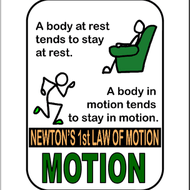
Newton’s Law of Motion and Mental Health
I’m no scientist and I don’t remember much about Physics, but I know all about inertia. It is easy for me to get stuck in a rut and I have to really push myself to get motivated. Some days are easier than others, but one thing’s for sure: lying on my couch doesn’t help. Once I get sucked into the couch vortex, I can disappear for hours. One hour leads to another and another. Before I know it, the day is almost over and I accomplished nothing. Then I think of all the things I should have done. Then I feel the guilt and shame and worthlessness. It’s a vicious cycle–the less I do, the worse I feel, and the more negative my thoughts become. So what does this have to do with Newton’s first Law of Motion? Everything.
In a game of dominoes, the dominoes remain still until one topples. When one moves, it causes the next to fall and so on. Bodies are no different. That’s why I need to make sure I get up and move during the day. It doesn’t need to be exercise or anything in particular, but if I don’t force myself to get up, I can easily stay there for a long time. Then the feeling and thoughts get going and soon I’m spiraling down a dark dark hole. However, if I can take one step no matter how small–topple one domino–it will often lead to the next one and I gain momentum.
The tricky part is that unless I have to be somewhere, I tend to stay put. Then I feel even worse for not doing anything when I had the time and the means. I swear working full-time is what kept me sane all those years. The great irony is that my mental illness prevents me from working full-time: I can’t handle the workload or the level of stress I took on before. It’s a constant challenge, but I try to catch it early and set myself in motion, often through the encouragement or accountability by a friend, peer, family member, therapist, etc. Many have told me that having a pet has saved their lives. Their pets give them purpose and force them to get up and walk them, feed them, play with them, and care for them. My pet, a sweet rescue cat named “Cinnamon,” prefers the couch so he isn’t much help in the get-up and get-moving department. He does give me joy, though. Thankfully, I have other things that keep me moving.
Finding ways to build in accountability and maintain a consistent routine can help so much. For me, volunteering and partial programs gave me that structure when I wasn’t able to provide it on my own. I had a specific time and place I needed to be. My therapy appointments and peer support group meetings helped me to get out, even if just for an hour or two. I learned to be gentle with myself and give myself credit for even the small tasks I completed. It feels good to cross something off a list, no matter how small it is. Accomplishing a goal builds momentum and moves energy in the right direction.
I still find myself drawn to the siren song of the couch, but it’s getting easier to steer away toward brighter shores. Sure, there are days I succumb and and crash, but I give myself grace, get back in my ship, and move on.
Congresswoman Susan Wild Loses Partner To Suicide
“We must act – removing the stigma cannot just be a slogan.”
For many it takes the loss of a love to realize or accept that mental illness can happen to anyone. I certainly never thought i would be diagnosed with one. I was a successful teacher, wife, and mother leading a stable, fulfilling life. I had overcome countless setbacks and reached (and at times exceeded) my goals. I was a straight A student with a Masters degree. An experienced actress and director. A wife and mother living in the suburbs with two healthy children. I assumed I was immune to such things.
I was wrong. I remember feeling such terrible shame, guilt, and horror that I didn’t tell anyone and hid behind closed doors. I thought I had done something wrong and it was all my fault. I felt worthless, hopeless, and helpless. All the light in my eyes had burned out and I became a shadow of my former self–literally, the walking dead doomed to live in an earthly purgatory–doomed to walk endlessly among the living, observing peace, happiness, love, and life but unable to partake in any of it.
Thanks to family, talk therapy, medication, medical procedures, peer support groups, education programs, and a stubborn constitution, I emerged on the other side a better person–a humble and healthier person with more perspective, gratitude, empathy, strength, and confidence. It’s ironic that through mental illness, I learned how to live a healthy life.
Sadly, that doesn’t happen for everyone and a large part of the reason is stigma. Stigma that is often more crippling than the disease itself. Stigma that is perpetuated by the media, the workplace, the health care system, societal ignorance, and isolation even from closest friends and family.
This is one reason I speak out–to give a face and a voice to a cause that still sits on the sidelines and is only addressed in response to violent crimes and tragedies. Wouldn’t it make more sense to take proactive measures to educate and improve mental health and reduce the stigma so people can lead fuller healthier lives? Perhaps if more attention were paid to promoting mental health, there wouldn’t be such high suicide rates that seem to increase each year? Why does it take a tragedy such as the loss of a loved one or a shooting rampage to discuss mental illness? Maybe if politicians focused more on mental health measures than gun control laws, prison reform, media violence, there would be fewer crimes and casualties in the first place. Who knows?
Anyway, I’m thankful to Congresswoman Wild for sharing her story and adding a voice to the battle.

Has a friend or family member told you to “snap out of it” or “get over it”?
I don’t know how many times I’ve heard these responses to my depression. As if it’s that easy. Anyone who tells you “You’re just having a bad day. You’ll feel better in the morning” has clearly not experienced the crippling agony and utter devastation of depression.
Thankfully, there are programs in place that help family members understand and support their loved ones with mental illness. The Depression and Bipolar Support Alliance (DBSA) and The National Alliance on Mental Illness (NAMI) run programs and support groups for family members and friends.
The Lehigh Valley DBSA holds weekly support group meetings on Wednesdays at First Presbyterian Church on Tilghman St in Allentown from 7-9 pm. Contact information can be found by clicking here.
Another resource to help friends and family members understand mental illness and support their loved ones is NAMI’s Family-to-Family program, a free 12-session educational program taught by trained family members who have been there.
If friends and family members are not able to attend support meetings or participate in programs, there are plenty of websites to guide them. I referred my husband here.

Using Humor To Cope
One of the hardest things I’ve ever had to do is resign from my job as a high school English and Theatre Arts teacher. From the time I lined up my stuffed animals on the basement stairs and taught them their ABCs, I had always wanted to be a teacher. After many years of hard work and sacrifice, I had achieved my Master’s in Education, reached the top of the pay scale, and possessed a retirement plan that seemed to be the envy of all. With tenure, seniority, and the support of a powerful and vocal union, I felt safe and secure. I loved being a teacher and devoted much (in retrospect, too much) of my time and energy there.
Then supportive and empowering administrators were replaced with critical and punitive ones. Teachers were forced to administer daily prescribed curriculum and threatened with insubordination for asking legitimate questions. District office personnel we had never even seen started penetrating the building, in search of anyone in violation. Esteemed teachers started leaving at alarming rates for new jobs, early retirements. Soon the toxic environment pushed me to my breaking point as well. In one day, I went from teaching in my classroom to being admitted to a hospital psychiatric unit. There’s nothing funny about that. But hold on.
I spent the next year and a half out on medical leave and worked on my recovery. As my brain healed and my confidence returned, the time came when I had to either return or resign. Devastated, but not wanting to risk a relapse, I waited until the very last day and resigned from teaching–the career I treasured and worked so hard to achieve. Still not funny, but wait–there’s more!
It took me YEARS to get over it and I harbored resentment until it ate me from the inside like a radioactive element. I had no idea how to channel all that pain, anger, and bitterness. Until one day, I just started laughing about how ridiculous my situation had become. I realized the absurdity and futility of remaining in the profession I once cherished and prided myself on my courage to leave. As if in a trance, I opened a Word document and my fingers found the keys and within ten minutes, I had written this short scene, which is based on an actual conversation I had with an administrator. I changed the end to reflect what most teachers who find themselves in this situation want to say, but can’t (that is, if they want to stay employed). So whenever I feel myself pining for the job I left behind or those angry, bitter feelings start to swell, I pull out this piece and chuckle anew.
So without further ado, I give to you BANG HEAD HERE:
PRINCIPAL, a 30-year-old male in tan dress pants and a light blue button-down collared shirt under a gray sports jacket sits at a large mahogany desk in his office leisurely scrolling through e-mail with a warm cup of coffee resting on upper right side of desk. TEACHER, a neatly dressed woman in her mid to late 40s, stands outside his office, anxiously waiting for PRINCIPAL’S attention and glancing at her watch. TEACHER wipes sweat from forehead and clears throat to get his attention.
P (looks up, but quickly resumes typing): I’ll be right with you. I’m just finishing up an e-mail.
T (glances again at watch uneasily, clearly annoyed): I can see you’re busy, but our appointment is scheduled for—
P (Still focused on screen, waving T into his air-conditioned office and continues to type): Oh, yes. Please have a seat. I’ll be right with you. (He grins and chuckles to himself, as if he’s crafted a witty post or created a new meme).
T: (Sitting in chair): I have to teach in ten minutes.
After a final emphatic click and a self-assured nod.
P: (Sighing and leaning back in leather high-backed swivel chair and folding hands behind his head). So, what brings you here?
T: As I mentioned in my e-mail, I wanted to address some concerns I have related to Anthony’s ongoing behavior in my class.
P: Oh yes, that’s right. Neat kid. (Nods head agreeably, though he has no clue who Anthony is). So, what seems to be the problem? (P leans forward to sip some coffee.)
T: (Matter of fact): Tony disrupts class on a daily basis and it’s making it difficult for the other students to learn.
P: Hmmm, I see. (He takes another sip and replaces cup, folds hands on desk.) So, what is he doing to disrupt the other students?
T: Well, yesterday he just got out of his seat and took another student’s pencil. Then he—
P (Cutting teacher off. Defensively.) Perhaps he needed one.
T: I don’t think so.
P: How do you know that?
T: He threw it out the window.
P: Wait. Why was he near the window?
T (Confused by question): Why was he—?
P: Yes, why was he by the window in the first place?
T: His case manager recommended Tony be able to get up and move as he feels the need. It’s part of his IEP. The point is he took another student’s pencil and—
P: Yes, I understand that. But why would he go to the window?
T: Probably to throw out the student’s pencil.
P: Why were the windows open?
T: It’s over 90 degrees today and there’s no air-conditioning in my room. It gets very hot in a small room with 30 students and it helps to–
P: In the future, just have him sit on the other side of the room so he isn’t near the window.
T (frustrated): He doesn’t sit near a window. He got out of his seat and walked over to the window. That’s when he grabbed a student’s pencil and tossed it—
P (Appears to be in thought) Now, I’m not suggesting…. Well, I’m wondering if…. Well, exactly what were the other students doing when Tommy got out of his seat?
T: Tony.
P: What? Oh, Tony. Yes, Tony.
T: They were writing in their journals.
P (Disapprovingly, turning mouth down): That’s a rather sedentary activity.
T: Well, it’s a five-minute freewriting exercise to get their ideas flowing and to generate material for their writing. It also helps with fluency.
P: (Confused): Fluency? (Beat.) Could this activity be more interactive?
T: After they write, they share what they’ve written with a peer. It’s just a warm up to get them—
P (Shakes head in confusion): A warm-up?
T: Yes, to get them thinking, writing, putting their thoughts—
P: Yes, but what do they DO with these thoughts?
T: It’s a prewriting activity for the first stage of the writing process. Eventually, their responses become—
P: Yes, but—
T: the basis for a thesis or a narrative or a poem.
P: But clearly, this is not an activity that engages ALL students so consider other ways for students to express their ideas. Otherwise, Tommy will continue to be disengaged and act out. I would suggest reaching out to other teachers for ideas on how to create more engaging lessons.
T: This was just a five-minute—
P: Well, let’s get back to Johnny. I mean, Tommy. How did you respond when he threw the pencil out of the window?
T: I gave the student another pencil so she could continue writing, but at that point, most of the students were reacting to Tony so I asked him to step out into the hall so I could speak to him privately, but he yelled “Fuck that! I’m going to the library!” and stormed out of the room.
P: So you just let him go? That sounds like you’re rewarding him.
T: Well, I couldn’t continue to follow him down the hall and leave the other 29 students unsupervised. I did call the library and they confirmed he was there.
P: Why didn’t you send him to his case manager?
T: She is co-teaching a class that period so she isn’t available. There is another case manager Tony can go to, but he refuses.
P: Have you talked to his case manager about this?
T (checks watch, starts to panic): Not face-to-face. I did send several e-mails to her as well as his guidance counselor explaining the ongoing situation, but I haven’t heard back yet. I’ve also spoken to his mom about his behavior.
P: And what did she say?
T: She said she gave up years ago and wished me luck.
(A brief pause ensues.)
P: You mentioned ongoing behavior? What other things has Tim done?
T: He calls out random things in the middle of class to get attention.
P (smiles and leans back in chair): Ah, so he’s comfortable speaking out in class. Perhaps you could find positive ways for him to use his voice and sense of humor?
T (shocked and confused): Sense of–??
P: He obviously wants to participate. Perhaps you could let him teach a lesson or assist in some other constructive way?
T: I tried that and it was a disaster. He ended up making faces at his classmates and telling jokes. I’d love to get him involved that way, but he would still need to follow the expectations, stay focused–
P: I’m sure he will once you give him some leadership. He hasn’t had problems in his other classes. Have you talked to them about what they’re doing?
T: Actually, I emailed all of his teachers this semester. Only two responded and they both said he acts the same way in their classes.
P: I must say, I’m surprised. We’ve never had any problems with Tim in the past.
T: Tony was expelled last year and spent the rest of the school year in alternative school.
P: I mean, this year.
T: (Checks watch.) Well, I have a class in one minute so –
P: Oh, have you met the Special Ed Lead Teacher? He’s a great resource, too.
T: Yes, we co-taught a class last year. (Rises to leave.)
P: I’m really glad we could figure this out.
T: Oh, I figured it out. You want me to waste taxpayers’ money and deny 29 other students their right to an education so I can escort a special needs student to the library because his case manager is co-teaching a class and isn’t even available as a resource, which is in clear violation of his IEP.
P: (Confused.)Wait. What???
Bell rings.
T: We can continue this conversation in my room after school. I’m in A125.
P is still processing, not sure what just happened.
T: (Turns back right before she enters the sweltering heat of the hallway.) Oh, and you might want to ditch the sports jacket. It’s hot.
END SCENE
.

Find Your Roots
As I was gathering material for this new blog site, I revisited an old blog I started 5 years ago. I wish I could have told my younger self not to worry so much and that it would all work out for the best. But then again, I needed to experience those lows to be able to fully appreciate where I’m at now. I needed to surround myself with people who would appreciate me and lift me up rather than undermine me and tear me down. While this site is dedicated toward helping others and advocacy, I started blogging five years ago to make sense of my life and the twists and turns it had taken. I wanted to form meaningful connections with others who struggled in similar ways. I longed to be authentic, but I worried people wouldn’t accept me. So I tried hard to be a person I was not and I felt even worse. You can find my old blog here: https://hidinginthespotlight.wordpress.com/
Now I am content with a smaller circle of friends and I put my time and energy into people who matter–people who will be there when the road is rough, people who aren’t just there when it’s convenient or they want something, people who I can be myself around.
When I was growing up, I remember my mom telling me I would be lucky to find just one true friend in life. At the time, I thought that was absurd and I figured she just wasn’t that popular or outgoing when she was my age. Besides, I had tons of friends. However, as I grew older, I learned the wisdom behind her words. I’m much happier being lifted up my a few loyal friends than surrounded by a group of people who will only end up bringing me down at a time when I need them most. Been there, done that. I respect myself too much now and I have come too far to play games and waste energy. After all, I only have so much energy these days and I need to invest it wisely. Lesson learned, mom.
I found the following tree analogy online, though I’m not sure who originated the idea of the “tree test.” Regardless, it resonates with me and I love it. Here it is:
WHAT KIND OF PERSON ARE YOU?
I have this tree analogy when I think of people in my life, be it friends, family, acquaintances, employees, co-workers, whomever…They are all placed inside what I call my tree test. It goes like this:
LEAF PEOPLE
Some people come into your life and they are like leaves on a tree. They are only there for a season. You can’t depend on them or count on them because they are weak and only there to give you shade. Like leaves, they are there to take what they need and as soon as it gets cold or a wind blows in your life they are gone. You can’t be angry at them, it’s just who they are.
BRANCH PEOPLE
There are some people who come into your life and they are like branches on a tree. They are stronger than leaves, but you have to be careful with them. They will stick around through most seasons, but if you go through a storm or two in your life it’s possible that you could lose them. Most times they break away when it’s tough. Although they are stronger than leaves, you have to test them out before you run out there and put all your weight on them. In most cases they can’t handle too much weight. But again, you can’t be mad with them, it’s just who they are.
ROOT PEOPLE
If you can find some people in your life who are like the roots of a tree then you have found something special. Like the roots of a tree, they are hard to find because they are not trying to be seen. Their only job is to hold you up and help you live a strong and healthy life. If you thrive, they are happy. They stay low key and don’t let the world know that they are there. And if you go through an awful storm they will hold you up. Their job is to hold you up, come what may, and to nourish you, feed you and water you.
Just as a tree has many limbs and many leaves, there are few roots. Look at your own life. How many leaves, branches and roots do you have? What are you in other people’s lives?
Hold On To Your Roots. Be the Root for Someone Else.
Depression Is A Serious Illness That Requires Treatment
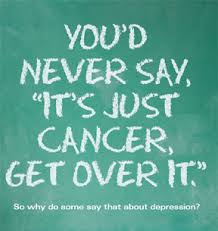
“Get over it.” This is one of the most frustrating responses I get during a bout of depression. Telling someone to “get over it” is like telling someone with broken legs to run a marathon. It defies common sense as depression affects the brain’s ability to think clearly in the first place. Others recommend going for a run or to the gym. If it were that simple, I would have already done that. I know that exercise helps with depression, but when just getting out of bed takes monumental effort, there isn’t much energy left for lacing up.
I don’t blame people who give this advice–in fact, I used to be one of them. I could never have realized the debilitating effects of depression until I experienced them firsthand. However, telling someone who is depressed to just “tough it out” or “snap out of it” points to a profound ignorance about mental health. No one would tell someone with cancer to just “deal with it” (nor should they), but depression is a life-threatening disease as well. Contrary to popular belief, depression is not just feeling tired or sad and upset over a recent loss. It is a serious life-long illness that requires treatment and while it can be managed with medication and lifestyle changes, there is no cure.
Sadly, there are many factors that prevent people from seeking help for a mental health condition. Perhaps the biggest deterrent is the stigma associated with mental illness. It seems mental illness only gets attention when some “crazy” person goes on a shooting rampage or a celebrity suffers a mental breakdown or commits suicide? This type of attention sensationalizes mental illness, instills fear, and attributes it to “the others”–often, the rich and famous or the truly criminal or deranged. It only perpetuates the stereotypes and misconceptions surrounding mental illness. Most mentally ill people do not commit crimes and should not be feared. Furthermore, mental illness affects people of all ages, races, genders, social classes, professions, etc. In fact, the National Institute of Health indicates that mental illness afflicts one in five American adults in any given year, and yet it remains a taboo and often misunderstood subject (2018).
Even though mental illness can be caused by environmental stresses, genetic factors, biochemical imbalances, or a combination, many view those with mental health conditions as “weak” or “lazy” or somehow at fault. Some of my own family members and friends have simply rolled their eyes at my pain and chalked it up to my being “dramatic” or “attention-seeking.” So, not only is someone with mental illness feared, he or she is further burdened with additional labels and made to feel “guilty,” “lazy,” or “ridiculous.” It is no surprise that so many people with mental illness feel rejected or ostracized, which only enhances isolation and feelings of worthlessness. When someone is seriously ill, people often rush to his or her aid delivering meals, sending flowers and cards, visiting them, and/or helping with household tasks or children. Cancer survivors are rightfully referred to as “warriors,” “survivors,” and “heroes.” But even though those with mental illness suffer, fight, and overcome tremendous battles as well, they are seldom honored and celebrated. Many survivors of serious health conditions say they could not have done it without the support of family, friends, colleagues, neighbors, yet many with mental illness find themselves with little support and few allies.
The shame and stigma with mental illness is so prevalent that some would rather suffer in silence (or even end their lives) than admit they have a mental disorder and seek help. Suicide is the 3rd leading cause of death in youths 10-24 and these rates are only rising (NAMI, 2018). Adolescents suffering from clinical depression increased by 37 percent between 2005 and 2014 (John Hopkins Health Review, 2017). Approximately 11 million U.S. adults aged 18 or older had at least one major depressive episode with severe impairment. (NIH, 2017). Clearly these statistics indicate a dire need for mental health intervention, yet there remains a significant deficit in providers and insurance coverage. Mental health programs continue to be cut or insufficiently funded. Research shows that nearly 60% of adults with a mental illness did not receive treatment (NAMI, 2018). With the lack of accessible treatment and the cost of comprehensive mental health care, on top of the stigma, it is not surprising that depression is the leading cause of disability worldwide (World Health Organization, 2017).
With limited access to care, those with mental illness often self-medicate with drugs and alcohol. In fact, 10.2 million adults have co-occuring mental health and addiction disorders (NAMI, 2018). Sadly, drugs and alcohol can be quicker and easier to obtain than an appointment with a therapist or psychiatrist. Furthermore, adding drugs and alcohol to mental illness compounds an already precarious situation. Mental illness can even be triggered by the use of drugs and alcohol. Like most illnesses, early intervention is key and yet little is being done with regards to mental illness other than sensational news coverage and punitive measures. There are valiant community efforts, support groups, dedicated volunteers, and a variety of helpful services and programs, but they are often limited in size and finances.
When will those with mental illness be treated with the dignity they deserve and not forced into silence and shame? When will mental health coverage and the number of providers and services meet the need? There is no simple solution, but each step, no matter how small, makes a difference. Each donation to mental health organizations such as the National Alliance on Mental Illness or the American Foundation for Suicide Prevention (AFSP), each time we speak out for those who cannot or lend a hand or call a friend, we are one step closer to change.
We never know who might be affected. It could be a family member you haven’t heard from in awhile, or a friend who suddenly stops coming to social events or a colleague who is out on a “medical leave.” It might be a child who smiles and seems to have it all, but self-harms behind closed doors. Now is the time to speak out, to share stories, to withhold judgment, to offer support, to seek treatment, to break down the wall of stigma before it takes the life of someone you know and love.

…And That’s a WRAP!
People have compared mental health treatment plans to emergency kits, toolboxes, lunchboxes and so on. These action plans are known as WRAPs (Wellness Recovery Action Plan). It doesn’t matter what you call it, but it’s important to create your own toolkit of strategies to use to stay well. It takes time to learn which tools work for you and when to use them. However, over time, you will discover the techniques that work best for you, just as a carpenter learns which tools to use for the job at hand. Research has shown that individuals with action plans manage their symptoms better and stay healthy for longer periods of times than those who have no plans in place.
So what do you put in this toolkit? Some common tools include exercise, talk therapy, medication, diet, peer support groups, and relaxation techniques like mindfulness, meditation, and deep breathing, Others use self-affirmations, mantras, and journaling and practice gratitude. Basically, anything that you need to do on a daily basis to maintain wellness can become part of your WRAP. Consider what you do when you are feeling well and incorporate those ideas and activities into your plan.
 Christina L. Dunbar