
Thank you to WFMZ for including me on a recent episode of Business Matters!

Thank you to WFMZ for including me on a recent episode of Business Matters!

I looked at the faces on my computer screen, the people in my support group with whom I’ve spent every Thursday night on Zoom for the past two years. As the facilitator, I try to stay positive, but one night I was really down. I had just gotten back from a girls’ weekend with two college friends, both of whom went on to have successful careers, one as a lawyer and the other as a high school principal.
I thought back to our college years and wondered what happened to me—the straight-A student who worked two part-time jobs, participated in choir, theatre, served as Philanthropy Chair in a sorority, and volunteered at a local school. I had looked forward to a bright future when all my hard work and dedication would pay off. And it did until a mental breakdown in my 40s upended my world.
Due to an unsupportive administration that exacerbated my mental health challenges, I had to give up my beloved career as a high school English and Drama teacher. As my college friends talked about juggling the demands of working full-time, raising children, and managing household tasks like cooking, cleaning, and paying bills, I felt like a failure. I can barely manage to work ten hours a week, my daughter is struggling with her own mental health issues, and my husband handles the majority of the household chores. I smiled and nodded, pretending to relate, but inside I felt broken and worthless.
As my support group shared how their week had gone, I debated whether or not to let them know how terrible I felt. As a leader, I didn’t want to take any focus off of them and I didn’t want to set a negative tone. But I needed to be honest. So I shared how difficult my weekend trip had been and how lonely and unaccomplished I felt.
Nicole, my fellow leader of the group, told me that she became a facilitator because I inspired her in one of the mental health courses I taught. She continued, “I know you feel like you’ve failed because you aren’t an English teacher anymore, but you are still teaching and impacting so many lives. More than you will ever know. So many people are here because of you.”
Another voice said, “I’m here because of you.”
Then another. “Me, too.”
My throat swelled and my heart filled with gratitude. A warm sensation spread throughout my body. I thanked them for their kind words and told them how much I needed to hear that.
Sometimes we can’t see what is right in front of us. Sometimes we get so caught up in what was supposed to be that we miss the beauty of what is. By pining for past employment or neglecting to explore other options, we rob ourselves of new and exciting opportunities and lasting, meaningful connections. We can still make a difference even if it’s not the way we had hoped or imagined. We can use our talents, skills, and experiences to enrich (even save) another’s life. I can’t think of anything more worthwhile than that. I may not have the money or the pension plan or the health insurance or the retirement benefits like I once did, but I have peace of mind and purpose and that is priceless.

When I’m feeling well, I feel very resilient, but when I’m not—when depression sets in as it inevitably does— I feel weak, like I’ve failed to stay well and I should have known better. I think, “How could I let this happen? Why didn’t I practice my coping skills better? How did I miss the warning signs?” I see others show remarkable resilience through unimaginable losses, severe illnesses, major defeats. I envy them as they bounce back or pivot or at least maintain a positive attitude. I think back to all the struggles and challenges I’d endured before my break—a chaotic childhood filled with divorces, arrests and restraining orders, bankruptcy at 22 due to cosigning with parent, father’s incarceration, three broken engagements, etc. I took it all in stride, barely missing a day of work. I prided myself on my resilience. Nothing seemed to bring me down until a toxic work environment and a cruel supervisor pushed me to the breaking point.
Now I can’t seem to bounce back, pivot, or think positively about anything. What happened to that resilient young woman who took everything in stride? My brain spins in an endless negative loop on a perfectly normal day. It can take the most positive event and turn it into gloom and doom. The slightest thing can set me back and undermine my confidence and worth. It’s like a dam in my brain has broken and it can no longer hold back the flood of negativity. Everyone around me seems to handle life with such grace, productivity, and positivity. I feel weak, lazy, vulnerable, embarrassed, ashamed, scared. I should be more productive, more grateful, more resilient—better.
And yet bipolar disorder is a brain disease. It clouds perceptions and disguises lies as truth. Maybe resilience looks differently for a bipolar person. Maybe resilience is getting up in the morning when a 100 lb weight is holding you down. Or showing up to an event when you want to isolate at home or finishing an assignment when your brain isn’t working. It makes no sense to compare my resilience to someone who doesn’t suffer from a brain disorder. A person with lung cancer will most likely not breathe as well as someone without it. It’s no weakness on that person’s part; it’s the nature of the illness. That person can try and try to breathe better, but it’s not going to happen. They can utilize tools that will help them to breathe easier, but they’re going to struggle to do it on their own. Isn’t the same true for bipolar? I can try and try to stay positive, to not let something get to me, but my brain will go there anyway. The brain can’t think and process things well if it’s sick so I have to use coping skills, medication, therapy to help me breathe easier, too.
It turns out my resilience shows the most when I’m not well. It takes strength to ride out the long and dark days of depression. It takes optimism to maintain a shred of hope when the brain tries to convince you it’s hopeless. It takes persistence to keep going when your body and brain want to give up. Resilience is shown in all kinds of ways and those with mental health conditions model resilience every day of their lives.


Sometimes you can do all the right things (e.g., practice gratitude, mindfulness, reframe distortions, use positive self-talk and affirmations, exercise, eat right) and depression can still rear its ugly old head in and leave you in a world of suck. I’ve really been struggling the past few weeks and my biggest fear is: what if I don’t get better? I know, rationally, that I will get better at some point and I just need to ride out yet another episode, but I still worry that no matter what I do I’ll never get better and I can’t live this way for the rest of my life. I need to remind myself that, as my therapist tells me, “that’s my anxiety and depression talking.” I need to challenge these distortions and tell my depression to “shut up!”
So let me reframe this distortion: “No matter what I do I’ll never get better.” This is not true nor is it helpful. I haven’t tried all possible medications and treatments so I can’t know that nothing will help (generalization). I also can’t know that I will never get better either (mind reading or predicting the future). However, if I tell myself that I won’t get better I will, no doubt, impede my progress.
A more rational thought would be: “There are many medications and treatments I haven’t tried. It may take time, but I will get better as I have many times before.”
Just by reframing my thought, I feel a little better. Each positive step I take is a step closer to wellness. Depression may have me in its grip right now, but I will get better. It’s only a matter of time.

Of all the wellness tips and techniques I’ve learned, the most impactful and surest way for me to stay healthy is through peer advocacy. Sharing my story and providing hope to others gives me purpose and value. It also reminds me how far I’ve come and how important it is to practice all of the strategies that I have learned along the way. After all, I don’t want to be a hypocrite who says one things but does another. So every time I give a presentation, teach a class, or run a support group, I get the chance to check in with myself. Am I practicing what I’m preaching? It’s a built in self-accountability system, for which I’m incredibly grateful. By helping others, I help myself. For me, it’s a no-brainer.
The value of peer advocacy cannot be overstated. I remember sitting in the hospital or various partial programs thinking, “where are all the people who are living well with mental illness?” I wanted to hear from someone who suffered from severe depression, anxiety, bipolar–someone feeling as hopeless as I did–but had come out on the other side and was doing well. I could read and learn all about mental illness and recovery, but until I saw someone on the outside who was managing their illness and leading a life in recovery, I couldn’t believe that it was possible for me, too. Sure, we read about celebrities with mental illness, which is brave and important, but I wasn’t a celebrity and those examples just weren’t relatable to me. I remember thinking, “If this famous person who has tons of money and resources and support can barely survive, what are my chances?” More often than not, their stories depressed me more.
Sadly, it is not easy to find people with mental health issues who are willing to speak out, especially if they are doing well. There is a definite risk involved and it’s foolish to think otherwise. While some employers may treat workers with mental illness fairly and respectfully, many will not. Once I disclosed my mental health condition, I was treated like a liability after 15 years of exemplary evaluations. Every classroom issue was automatically attributed to something I was doing wrong. Eventually, it reached the point where I had to resign to maintain my health and dignity. Despite valiant efforts to end the stigma surrounding mental illness, it remains as strong as ever and it silences peers who could give so much hope to others. I get it, though. I really do. When you work like hell to get yourself employed again, you certainly don’t want to risk your job by revealing a mental health condition. Rather than seeing the ability to manage an illness as a testament to a person’s strength, bravery, and resilience, some will, undoubtedly, view it as a weakness and treat him/her/them as less than.
Through my advocacy, I hope to inspire others to speak out and share their truth. Right now I am the only person who is trained in our NAMI affiliate to teach classes, speak to organizations, and facilitate support groups. There are others who are trained in one or the other, but often it comes down to me. And I can only do so much. We need others and our impact can be great. Until society regularly sees people with mental illness who are skilled, knowledgeable, and successful, the stereotypes and misperceptions will continue. Often the ones who do reveal their mental health conditions have already established themselves as experts or celebrities so they are already acknowledged and accepted in their careers. Of course it helps to hear from those people, but where is the voice of the working class person– the group to which the majority belongs. We are here, but we cannot be heard until more of us speak out and act in ways that dispel all those dangerous misconceptions. If all society sees of mental illness is the lone shooter or a ranting celebrity, how can society change its view on mental health conditions?
Please consider joining me in the fight to give a voice to mental illness–that it isn’t something to fear. It doesn’t just affect that one eccentric relative that others tell funny stories about–or won’t talk about at all. Since one out of four people in the US has a mental illness, chances are you know someone right now who is suffering. It might be the person you least expect, too. Most people with mental health conditions are experts at hiding it, (which is sad since they should be using the little bit of energy they have for self-care). Furthermore, no one is immune. I never thought it could happen to me. Until it did.
It’s time to end the silence that perpetuates the stigma surrounding mental illness. By sharing and listening to each other’s stories, we validate each other and strengthen our collective voice. As peers, we have the power to truly make a difference in the way that no other source can.

So grateful to have been included in the mental health initiative panel discussion with Governor Wolf, Rep. Mike Schlossberg, and Dr. Rachel Levine held today at Muhlenberg College. Through new initiatives and candid conversation, I am hopeful that mental health will receive the same attention, care, and consideration as physical health conditions. By speaking out, eliminating barriers, and improving the quantity and quality of resources, countless lives will be saved and hope and dignity will be restored to those suffering from mental health conditions. Stand proud and speak your truth!
To read more about this event, click here
ON RECOVERY
Recently, a friend shared the following post regarding her recovery from cancer on Facebook:
“I’ve been cancer-free for almost nine months. Some days, I can’t tell if I’m recovering from all of the treatments because it takes so long to recover. But, then I look back on the past nine months and realize that I’ve come a long way. Here’s how I know I’m getting better:
-9 Months Ago: Couldn’t do three push-ups without collapsing.
-Today: Did 20 of them.
-9 Months Ago: I could barely lift 20 pounds.
-Yesterday: I did 48kg deadlifts (I forget how to convert that number into pounds).
-9 Months Ago: Couldn’t run a mile in less than 14 minutes.
-Today: I run multiple miles in less than 12-minute miles… getting closer to 11-minute miles.
-9 Months Ago: Sometimes, I slid down the stairs because chemo made my feet numb and it was easier to slide than try to walk down the stairs.
-Today: I still hold onto the railing for dear life, but I let go on the last few stairs, now.
So, when I type it out like this, I see that there is so much to celebrate on this birthday. I’m still praying for a full recovery, but, really, I’m just grateful to be here and to know so many wonderful people”
***************************************************************************
Naturally, I was thrilled to read of her progress and all the supportive comments that followed her post. Then I thought about how far I’ve come with my own illness and I felt grateful, too. But I wondered: what responses would I get if I posted my progress regarding my mental health condition? Would people think I was just seeking attention, exaggerating, or minimizing my friend’s struggle with cancer? Would others even read it? If they did, would they just roll their eyes and move on? Or would they avoid me the next time they saw me in person, as if my depression might somehow infect them?
I understand that people might not know what to say to someone who struggles from depression, but saying nothing just makes a person feel more ashamed, more worthless, more invisible, and more alone. So here is my celebration of my progress within the past 7 years
My Recovery from a Mental Health Condition:
“7 years ago, my brain broke and I was diagnosed with bipolar II and major depression. I felt like I was given a death sentence, because there is no cure for mental health conditions and I will never be “free” of it. Some days, I struggle with feelings of worthlessness, fatigue, and loss of purpose and identity; It all seems too much to bear. But, then I remember how far I’ve come and how much I’ve learned. Here’s how I know I’m doing better:
-7 Years Ago: I was so ashamed and embarrassed, I isolated. I had no idea what was wrong with me or how to get better.
-Today: I have shared my story publicly and strategies I use to stay well with hundreds of patients and peers and teach NAMI education courses on an ongoing basis.
-7 Years Ago: I had 30 rounds of ECT and had difficulty remembering things and communicating my thoughts.
-Today: I regained my short-term memory, my brain responds to medication, and I am able to manage side effects.
-7 Years Ago: I was unable to work and convinced I’d never work again, let alone teach.
-Today: I have several jobs that allow me to use the skills I’ve spent my whole life building (NCC, NAMI, PBS, and TUTOR DR)
-7 Years Ago: I wanted to die to stop the persistent feelings of worthlessness, hopelessness, and despair
-Today: I enjoy life and I know I have worth, purpose, and hope.
-7 Years Ago, I could barely get out of bed, get dressed, shower, and complete basic household chores
-Today: I get out of bed, complete household chores, and take care of my child on a regular basis.
-7 Years Ago: I didn’t even want to leave the house and took no pleasure in any of the things I once loved.
-Today: I direct school plays, sing in a band, perform in community theatre, and maintain my own blog.
So, when I type it out like this, I see that there is so much to celebrate, though many will still consider me “weak,” “lazy,” “crazy,” or “over-dramatic.” I know this will be a lifelong battle and there will be relapses, but I’m grateful to be here and to have the knowledge and skills to manage my condition, educate the public, and inspire hope to others with mental health conditions.
Why is a mental health condition treated differently than a physical one? Both are life-threatening medical conditions that affect millions of people. Both require extensive treatments and medications with crippling side effects. Yet someone with cancer is accepted, acknowledged, and supported while someone with a mental health condition is questioned, avoided, shamed, and blamed. No one says to someone with cancer, “get over it,” or “you’re just too lazy to work” or “you just want sympathy” or “there are days I feel like I have cancer, too.” That would be ridiculous. Yet, people with mental illness hear that all the time. Is a person who is battling mental health condition any less of a warrior, role model, or hero? My friend is resilient, strong, and courageous. So am I. So is anyone who fights daily to overcome any other debilitating disease. Just because an illness cannot be seen doesn’t mean it isn’t there or is any less serious.
Until mental health conditions are given the same respect, attention, and care as physical health conditions, the stigma surrounding mental illness will continue and people will suffer in silence and shame. Precious lives will be taken that might have been saved. If you are struggling with mental illness, you are not alone. You are seen, heard, honored, and loved more than you could ever know. Fight on, brave warrior—we see you, we hear you, we honor you.
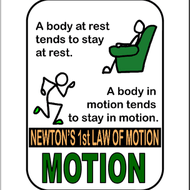
I’m no scientist and I don’t remember much about Physics, but I know all about inertia. It is easy for me to get stuck in a rut and I have to really push myself to get motivated. Some days are easier than others, but one thing’s for sure: lying on my couch doesn’t help. Once I get sucked into the couch vortex, I can disappear for hours. One hour leads to another and another. Before I know it, the day is almost over and I accomplished nothing. Then I think of all the things I should have done. Then I feel the guilt and shame and worthlessness. It’s a vicious cycle–the less I do, the worse I feel, and the more negative my thoughts become. So what does this have to do with Newton’s first Law of Motion? Everything.
In a game of dominoes, the dominoes remain still until one topples. When one moves, it causes the next to fall and so on. Bodies are no different. That’s why I need to make sure I get up and move during the day. It doesn’t need to be exercise or anything in particular, but if I don’t force myself to get up, I can easily stay there for a long time. Then the feeling and thoughts get going and soon I’m spiraling down a dark dark hole. However, if I can take one step no matter how small–topple one domino–it will often lead to the next one and I gain momentum.
The tricky part is that unless I have to be somewhere, I tend to stay put. Then I feel even worse for not doing anything when I had the time and the means. I swear working full-time is what kept me sane all those years. The great irony is that my mental illness prevents me from working full-time: I can’t handle the workload or the level of stress I took on before. It’s a constant challenge, but I try to catch it early and set myself in motion, often through the encouragement or accountability by a friend, peer, family member, therapist, etc. Many have told me that having a pet has saved their lives. Their pets give them purpose and force them to get up and walk them, feed them, play with them, and care for them. My pet, a sweet rescue cat named “Cinnamon,” prefers the couch so he isn’t much help in the get-up and get-moving department. He does give me joy, though. Thankfully, I have other things that keep me moving.
Finding ways to build in accountability and maintain a consistent routine can help so much. For me, volunteering and partial programs gave me that structure when I wasn’t able to provide it on my own. I had a specific time and place I needed to be. My therapy appointments and peer support group meetings helped me to get out, even if just for an hour or two. I learned to be gentle with myself and give myself credit for even the small tasks I completed. It feels good to cross something off a list, no matter how small it is. Accomplishing a goal builds momentum and moves energy in the right direction.
I still find myself drawn to the siren song of the couch, but it’s getting easier to steer away toward brighter shores. Sure, there are days I succumb and and crash, but I give myself grace, get back in my ship, and move on.

One of the hardest things I’ve ever had to do is resign from my job as a high school English and Theatre Arts teacher. From the time I lined up my stuffed animals on the basement stairs and taught them their ABCs, I had always wanted to be a teacher. After many years of hard work and sacrifice, I had achieved my Master’s in Education, reached the top of the pay scale, and possessed a retirement plan that seemed to be the envy of all. With tenure, seniority, and the support of a powerful and vocal union, I felt safe and secure. I loved being a teacher and devoted much (in retrospect, too much) of my time and energy there.
Then supportive and empowering administrators were replaced with critical and punitive ones. Teachers were forced to administer daily prescribed curriculum and threatened with insubordination for asking legitimate questions. District office personnel we had never even seen started penetrating the building, in search of anyone in violation. Esteemed teachers started leaving at alarming rates for new jobs, early retirements. Soon the toxic environment pushed me to my breaking point as well. In one day, I went from teaching in my classroom to being admitted to a hospital psychiatric unit. There’s nothing funny about that. But hold on.
I spent the next year and a half out on medical leave and worked on my recovery. As my brain healed and my confidence returned, the time came when I had to either return or resign. Devastated, but not wanting to risk a relapse, I waited until the very last day and resigned from teaching–the career I treasured and worked so hard to achieve. Still not funny, but wait–there’s more!
It took me YEARS to get over it and I harbored resentment until it ate me from the inside like a radioactive element. I had no idea how to channel all that pain, anger, and bitterness. Until one day, I just started laughing about how ridiculous my situation had become. I realized the absurdity and futility of remaining in the profession I once cherished and prided myself on my courage to leave. As if in a trance, I opened a Word document and my fingers found the keys and within ten minutes, I had written this short scene, which is based on an actual conversation I had with an administrator. I changed the end to reflect what most teachers who find themselves in this situation want to say, but can’t (that is, if they want to stay employed). So whenever I feel myself pining for the job I left behind or those angry, bitter feelings start to swell, I pull out this piece and chuckle anew.
So without further ado, I give to you BANG HEAD HERE:
PRINCIPAL, a 30-year-old male in tan dress pants and a light blue button-down collared shirt under a gray sports jacket sits at a large mahogany desk in his office leisurely scrolling through e-mail with a warm cup of coffee resting on upper right side of desk. TEACHER, a neatly dressed woman in her mid to late 40s, stands outside his office, anxiously waiting for PRINCIPAL’S attention and glancing at her watch. TEACHER wipes sweat from forehead and clears throat to get his attention.
P (looks up, but quickly resumes typing): I’ll be right with you. I’m just finishing up an e-mail.
T (glances again at watch uneasily, clearly annoyed): I can see you’re busy, but our appointment is scheduled for—
P (Still focused on screen, waving T into his air-conditioned office and continues to type): Oh, yes. Please have a seat. I’ll be right with you. (He grins and chuckles to himself, as if he’s crafted a witty post or created a new meme).
T: (Sitting in chair): I have to teach in ten minutes.
After a final emphatic click and a self-assured nod.
P: (Sighing and leaning back in leather high-backed swivel chair and folding hands behind his head). So, what brings you here?
T: As I mentioned in my e-mail, I wanted to address some concerns I have related to Anthony’s ongoing behavior in my class.
P: Oh yes, that’s right. Neat kid. (Nods head agreeably, though he has no clue who Anthony is). So, what seems to be the problem? (P leans forward to sip some coffee.)
T: (Matter of fact): Tony disrupts class on a daily basis and it’s making it difficult for the other students to learn.
P: Hmmm, I see. (He takes another sip and replaces cup, folds hands on desk.) So, what is he doing to disrupt the other students?
T: Well, yesterday he just got out of his seat and took another student’s pencil. Then he—
P (Cutting teacher off. Defensively.) Perhaps he needed one.
T: I don’t think so.
P: How do you know that?
T: He threw it out the window.
P: Wait. Why was he near the window?
T (Confused by question): Why was he—?
P: Yes, why was he by the window in the first place?
T: His case manager recommended Tony be able to get up and move as he feels the need. It’s part of his IEP. The point is he took another student’s pencil and—
P: Yes, I understand that. But why would he go to the window?
T: Probably to throw out the student’s pencil.
P: Why were the windows open?
T: It’s over 90 degrees today and there’s no air-conditioning in my room. It gets very hot in a small room with 30 students and it helps to–
P: In the future, just have him sit on the other side of the room so he isn’t near the window.
T (frustrated): He doesn’t sit near a window. He got out of his seat and walked over to the window. That’s when he grabbed a student’s pencil and tossed it—
P (Appears to be in thought) Now, I’m not suggesting…. Well, I’m wondering if…. Well, exactly what were the other students doing when Tommy got out of his seat?
T: Tony.
P: What? Oh, Tony. Yes, Tony.
T: They were writing in their journals.
P (Disapprovingly, turning mouth down): That’s a rather sedentary activity.
T: Well, it’s a five-minute freewriting exercise to get their ideas flowing and to generate material for their writing. It also helps with fluency.
P: (Confused): Fluency? (Beat.) Could this activity be more interactive?
T: After they write, they share what they’ve written with a peer. It’s just a warm up to get them—
P (Shakes head in confusion): A warm-up?
T: Yes, to get them thinking, writing, putting their thoughts—
P: Yes, but what do they DO with these thoughts?
T: It’s a prewriting activity for the first stage of the writing process. Eventually, their responses become—
P: Yes, but—
T: the basis for a thesis or a narrative or a poem.
P: But clearly, this is not an activity that engages ALL students so consider other ways for students to express their ideas. Otherwise, Tommy will continue to be disengaged and act out. I would suggest reaching out to other teachers for ideas on how to create more engaging lessons.
T: This was just a five-minute—
P: Well, let’s get back to Johnny. I mean, Tommy. How did you respond when he threw the pencil out of the window?
T: I gave the student another pencil so she could continue writing, but at that point, most of the students were reacting to Tony so I asked him to step out into the hall so I could speak to him privately, but he yelled “Fuck that! I’m going to the library!” and stormed out of the room.
P: So you just let him go? That sounds like you’re rewarding him.
T: Well, I couldn’t continue to follow him down the hall and leave the other 29 students unsupervised. I did call the library and they confirmed he was there.
P: Why didn’t you send him to his case manager?
T: She is co-teaching a class that period so she isn’t available. There is another case manager Tony can go to, but he refuses.
P: Have you talked to his case manager about this?
T (checks watch, starts to panic): Not face-to-face. I did send several e-mails to her as well as his guidance counselor explaining the ongoing situation, but I haven’t heard back yet. I’ve also spoken to his mom about his behavior.
P: And what did she say?
T: She said she gave up years ago and wished me luck.
(A brief pause ensues.)
P: You mentioned ongoing behavior? What other things has Tim done?
T: He calls out random things in the middle of class to get attention.
P (smiles and leans back in chair): Ah, so he’s comfortable speaking out in class. Perhaps you could find positive ways for him to use his voice and sense of humor?
T (shocked and confused): Sense of–??
P: He obviously wants to participate. Perhaps you could let him teach a lesson or assist in some other constructive way?
T: I tried that and it was a disaster. He ended up making faces at his classmates and telling jokes. I’d love to get him involved that way, but he would still need to follow the expectations, stay focused–
P: I’m sure he will once you give him some leadership. He hasn’t had problems in his other classes. Have you talked to them about what they’re doing?
T: Actually, I emailed all of his teachers this semester. Only two responded and they both said he acts the same way in their classes.
P: I must say, I’m surprised. We’ve never had any problems with Tim in the past.
T: Tony was expelled last year and spent the rest of the school year in alternative school.
P: I mean, this year.
T: (Checks watch.) Well, I have a class in one minute so –
P: Oh, have you met the Special Ed Lead Teacher? He’s a great resource, too.
T: Yes, we co-taught a class last year. (Rises to leave.)
P: I’m really glad we could figure this out.
T: Oh, I figured it out. You want me to waste taxpayers’ money and deny 29 other students their right to an education so I can escort a special needs student to the library because his case manager is co-teaching a class and isn’t even available as a resource, which is in clear violation of his IEP.
P: (Confused.)Wait. What???
Bell rings.
T: We can continue this conversation in my room after school. I’m in A125.
P is still processing, not sure what just happened.
T: (Turns back right before she enters the sweltering heat of the hallway.) Oh, and you might want to ditch the sports jacket. It’s hot.
END SCENE
.
 Christina L. Dunbar