
Category: Uncategorized
Another Suicide Note
Found another suicide note in my thirteen year old’s daughter’s bedroom. The note is more specific than the first one we found last summer that upended our lives. This time she has a date and a means (“OD on whatever she can find” or “hang.”) She’s becoming more savvy. Tons of questions plague my mind: What did I do wrong? How can I help her? Why didn’t I pick up on this sooner?
I knew she was struggling with social anxiety, which led to some depression, but we thought the meds and therapy were helping. They aren’t and we’ve been at this a year now. We’ve connected her with weekly therapy, an eating disorder therapist, a child psychiatrist, a dietician, and even equine therapy. At the beginning of the school year, we sat down with her teachers and school administrators and worked out a 504 education plan, scheduled weekly check ins with school counselor, and connected her with a Communities In School program to build her coping skills and provide additional teacher and peer support. We enrolled her in guitar lessons at School of Rock. None of this was enough.
We ended up having to hospitalize her a month ago, which was the hardest thing I’ve ever had to do, especially since we’re in the middle of a pandemic and couldn’t even visit her. We had ten minute phone calls three times a day, which consisted of her crying and begging us to get her out. It’s been one step forward and two steps back ever since.
So today I called to get her into a partial program, but they take in-network psychiatrist referrals first and they’re maxed out anyway. Recommendation—keep calling back. No waiting list option. So I add that to my daily list of things to do to keep my daughter alive. While my friends complain of running their kids back and forth to activities and their children not eating their vegetables, I’m just hoping I can get food into my daughter that she’ll actually keep down. In addition to severe anxiety and major depression, we’ve unearthed an eating disorder, which we didn’t even suspect until she dropped 11 pounds in two months. She’s always had texture sensitivity and poor eating habits, but we didn’t know she was restricting calories and purging. I thought she was scared of throwing up. Clearly I was wrong.
Anyway, we’ve been busily doing all we can to support her. We don’t have any family in the area and our parents are elderly and in poor health, which is stressful in its own right, so it’s been the two of us blindly navigating these treacherous waters. Most of the time we’re barely treading water. Or we’re sinking, frantically clutching to anything that will keep our heads above water until the next onslaught. Every time we dodge one wave, we get blind-sided by another. The waters are never calm. Not anymore.
If you are a parent and your child is struggling, please know that you are not alone. We can win this battle, but it’s going to require a lot of armor and weapons and strength and courage and fight. NAMI offers free support groups and classes for friends and family members whose loved ones have mental health conditions.

The Riddle of Resilience
When I’m feeling well, I feel very resilient, but when I’m not—when depression sets in as it inevitably does— I feel weak, like I’ve failed to stay well and I should have known better. I think, “How could I let this happen? Why didn’t I practice my coping skills better? How did I miss the warning signs?” I see others show remarkable resilience through unimaginable losses, severe illnesses, major defeats. I envy them as they bounce back or pivot or at least maintain a positive attitude. I think back to all the struggles and challenges I’d endured before my break—a chaotic childhood filled with divorces, arrests and restraining orders, bankruptcy at 22 due to cosigning with parent, father’s incarceration, three broken engagements, etc. I took it all in stride, barely missing a day of work. I prided myself on my resilience. Nothing seemed to bring me down until a toxic work environment and a cruel supervisor pushed me to the breaking point.
Now I can’t seem to bounce back, pivot, or think positively about anything. What happened to that resilient young woman who took everything in stride? My brain spins in an endless negative loop on a perfectly normal day. It can take the most positive event and turn it into gloom and doom. The slightest thing can set me back and undermine my confidence and worth. It’s like a dam in my brain has broken and it can no longer hold back the flood of negativity. Everyone around me seems to handle life with such grace, productivity, and positivity. I feel weak, lazy, vulnerable, embarrassed, ashamed, scared. I should be more productive, more grateful, more resilient—better.
And yet bipolar disorder is a brain disease. It clouds perceptions and disguises lies as truth. Maybe resilience looks differently for a bipolar person. Maybe resilience is getting up in the morning when a 100 lb weight is holding you down. Or showing up to an event when you want to isolate at home or finishing an assignment when your brain isn’t working. It makes no sense to compare my resilience to someone who doesn’t suffer from a brain disorder. A person with lung cancer will most likely not breathe as well as someone without it. It’s no weakness on that person’s part; it’s the nature of the illness. That person can try and try to breathe better, but it’s not going to happen. They can utilize tools that will help them to breathe easier, but they’re going to struggle to do it on their own. Isn’t the same true for bipolar? I can try and try to stay positive, to not let something get to me, but my brain will go there anyway. The brain can’t think and process things well if it’s sick so I have to use coping skills, medication, therapy to help me breathe easier, too.
It turns out my resilience shows the most when I’m not well. It takes strength to ride out the long and dark days of depression. It takes optimism to maintain a shred of hope when the brain tries to convince you it’s hopeless. It takes persistence to keep going when your body and brain want to give up. Resilience is shown in all kinds of ways and those with mental health conditions model resilience every day of their lives.

“I wish I knew what to say.”
I hear this a lot when I’m in the midst of a depressive episode. It’s understandable that someone who doesn’t suffer from depression wouldn’t know what to say. Thankfully there are plenty of resources and services out there to educate oneself and learn. This article, in particular, provides some helpful advice for caregivers, friends, and loved ones of those with mental illness. You can make a difference. You can save a life. Here’s how: https://www.bphope.com/bipolar-buzz/the-best-things-you-can-do-for-a-friend-with-bipolar-disorder/?utm_source=iContact&utm_medium=email&utm_campaign=hh-headlines&utm_content=Weekend+-+Jan15+-+Triggers

Keeping It Real
Sometimes you can do all the right things (e.g., practice gratitude, mindfulness, reframe distortions, use positive self-talk and affirmations, exercise, eat right) and depression can still rear its ugly old head in and leave you in a world of suck. I’ve really been struggling the past few weeks and my biggest fear is: what if I don’t get better? I know, rationally, that I will get better at some point and I just need to ride out yet another episode, but I still worry that no matter what I do I’ll never get better and I can’t live this way for the rest of my life. I need to remind myself that, as my therapist tells me, “that’s my anxiety and depression talking.” I need to challenge these distortions and tell my depression to “shut up!”
So let me reframe this distortion: “No matter what I do I’ll never get better.” This is not true nor is it helpful. I haven’t tried all possible medications and treatments so I can’t know that nothing will help (generalization). I also can’t know that I will never get better either (mind reading or predicting the future). However, if I tell myself that I won’t get better I will, no doubt, impede my progress.
A more rational thought would be: “There are many medications and treatments I haven’t tried. It may take time, but I will get better as I have many times before.”
Just by reframing my thought, I feel a little better. Each positive step I take is a step closer to wellness. Depression may have me in its grip right now, but I will get better. It’s only a matter of time.
Beating the Bipolar Blues
During this time of year, my mood often plummets. Whether it’s due to less daylight, colder temperatures, less physical activity, back to school blues, or triggering family holidays, I become more irritable and sad. This article contains lots of good advice to beat those blues! https://www.healthline.com/health/bipolar-disorder/depression?utm_source=facebook&utm_medium=opt&utm_campaign=vrayler-interest-bipolar-hl-dynamic&fbclid=IwAR2ismr5NzlO1b_ywtoTl4oji3KOPCyBFOKuY0q5yZi29vSP8NLcCf84T8w#beactive
Making the Most of Therapy Sessions
Have you ever left a therapy session or psych doc appointment thinking, ugh. I forgot to ask about x!
It happens all the time to me. I either forget to make a note of it, or lose that note, or forget to mention it during the appointment.
This article has some great advice https://www.healthline.com/health/bipolar-disorder/therapist-visit-guide?utm_source=facebook&utm_medium=opt&utm_campaign=vraylar-interest-bipolar-hl-dynamic&fbclid=IwAR0jcMk6cZNyzc7wTJx4lZsk8pI7BwDqkz5jhWRh8s_sgVGJICYc1EbOGUE#Do%20your%20homework
I keep my notes on the Notes app on my phone. That way I always have them with me since they’re on my phone. Plus I can email my notes to myself if I need to print or want to save on my computer. Here’s another cool trick that has saved me a lot of time—if you open Notes app, and select the camera icon, you can scan documents. Just position camera above a centered document and it automatically captures the image and you can upload it. Or just take a pic. Who knew?!

The Power of Peer Advocacy
Of all the wellness tips and techniques I’ve learned, the most impactful and surest way for me to stay healthy is through peer advocacy. Sharing my story and providing hope to others gives me purpose and value. It also reminds me how far I’ve come and how important it is to practice all of the strategies that I have learned along the way. After all, I don’t want to be a hypocrite who says one things but does another. So every time I give a presentation, teach a class, or run a support group, I get the chance to check in with myself. Am I practicing what I’m preaching? It’s a built in self-accountability system, for which I’m incredibly grateful. By helping others, I help myself. For me, it’s a no-brainer.
The value of peer advocacy cannot be overstated. I remember sitting in the hospital or various partial programs thinking, “where are all the people who are living well with mental illness?” I wanted to hear from someone who suffered from severe depression, anxiety, bipolar–someone feeling as hopeless as I did–but had come out on the other side and was doing well. I could read and learn all about mental illness and recovery, but until I saw someone on the outside who was managing their illness and leading a life in recovery, I couldn’t believe that it was possible for me, too. Sure, we read about celebrities with mental illness, which is brave and important, but I wasn’t a celebrity and those examples just weren’t relatable to me. I remember thinking, “If this famous person who has tons of money and resources and support can barely survive, what are my chances?” More often than not, their stories depressed me more.
Sadly, it is not easy to find people with mental health issues who are willing to speak out, especially if they are doing well. There is a definite risk involved and it’s foolish to think otherwise. While some employers may treat workers with mental illness fairly and respectfully, many will not. Once I disclosed my mental health condition, I was treated like a liability after 15 years of exemplary evaluations. Every classroom issue was automatically attributed to something I was doing wrong. Eventually, it reached the point where I had to resign to maintain my health and dignity. Despite valiant efforts to end the stigma surrounding mental illness, it remains as strong as ever and it silences peers who could give so much hope to others. I get it, though. I really do. When you work like hell to get yourself employed again, you certainly don’t want to risk your job by revealing a mental health condition. Rather than seeing the ability to manage an illness as a testament to a person’s strength, bravery, and resilience, some will, undoubtedly, view it as a weakness and treat him/her/them as less than.
Through my advocacy, I hope to inspire others to speak out and share their truth. Right now I am the only person who is trained in our NAMI affiliate to teach classes, speak to organizations, and facilitate support groups. There are others who are trained in one or the other, but often it comes down to me. And I can only do so much. We need others and our impact can be great. Until society regularly sees people with mental illness who are skilled, knowledgeable, and successful, the stereotypes and misperceptions will continue. Often the ones who do reveal their mental health conditions have already established themselves as experts or celebrities so they are already acknowledged and accepted in their careers. Of course it helps to hear from those people, but where is the voice of the working class person– the group to which the majority belongs. We are here, but we cannot be heard until more of us speak out and act in ways that dispel all those dangerous misconceptions. If all society sees of mental illness is the lone shooter or a ranting celebrity, how can society change its view on mental health conditions?
Please consider joining me in the fight to give a voice to mental illness–that it isn’t something to fear. It doesn’t just affect that one eccentric relative that others tell funny stories about–or won’t talk about at all. Since one out of four people in the US has a mental illness, chances are you know someone right now who is suffering. It might be the person you least expect, too. Most people with mental health conditions are experts at hiding it, (which is sad since they should be using the little bit of energy they have for self-care). Furthermore, no one is immune. I never thought it could happen to me. Until it did.
It’s time to end the silence that perpetuates the stigma surrounding mental illness. By sharing and listening to each other’s stories, we validate each other and strengthen our collective voice. As peers, we have the power to truly make a difference in the way that no other source can.
You Are Not Alone
Dealing with mental illness is tough enough, but add a pandemic and nationwide protests and it can feel even more overwhelming and isolating, especially when you are stuck at home and don’t feel like you can do anything about it. The situation feels hopeless and those old, familiar feelings of despair set in. While it’s important to respect and validate those feelings, it’s also important to move forward. Easier said than done, I know. I know all about the vicious cycle of negativity and nothingness–that whole thought/feeling/behavior nightmare of “I think I’m worthless” so “I do nothing” and then “I feel even more worthless.” At some point, though, you have to just say “Enough! I am not listening to YOU anymore.” Then fill your head with OTHER, more productive thoughts (yes, even if you don’t believe them).
Now more than ever, we need people to talk to, someone to listen, someone to relate to, someone to acknowledge that we matter, that we do have power, that we can do something. It may not be what we want, but every step forward, no matter how small, moves us closer to where we want to be–to that final destination of safety, contentment, acceptance, calm, understanding.
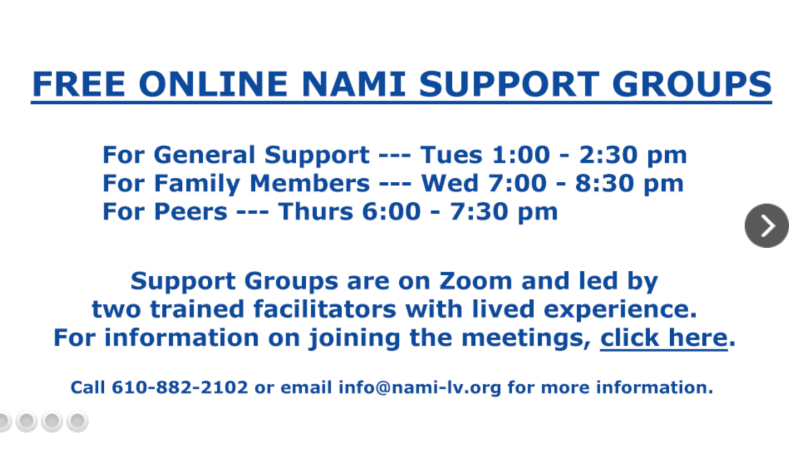
But where can we find those other people who will offer support, guidance, or just listen without judgment? This is where NAMI comes into play. There are people who are professionally trained to listen, peers who struggle with anxiety and/or depression and have learned healthy ways to cope with their illnesses. I am proud that my local NAMI affiliate offers THREE online weekly support groups for those who are struggling during these uncertain, challenging times. To find out more about these FREE weekly sessions, visit http://www.nami-lv.org/
We will get through this TOGETHER. We will come out STRONGER.
Practice Gratitude As If Your Life Depends On It–Because It Can.
It is so difficult to think positively when you are genetically wired for glass-half-empty thoughts. Whenever something good happens to me, I brace myself for the inevitable defeat, which I am convinced will follow. I’m sure I’ve created much of my own misery simply by thinking it into being. Sad, but true.
Most experts agree that it takes at least 21 days to form a new habit. Even the simplest behaviors take time and repeated practice to move them into automatic actions. Thoughts are no different. At first, it may feel forced and false to focus on the positive or practice gratitude when you really just want to go to bed and never wake up. However, that is when it is even more critical to stop the negative thought cycle and turn to gratitude. The brain cannot think two thoughts at the same time so every minute you spend on gratitude is one minute less of the “stinking thinking.” That, in itself, is a victory. Also, one expression of gratitude can lead to more positive or grateful thoughts and before you know it, you may, and most likely will, find yourself feeling a bit better.
One reason for that is the law of attraction. Good thoughts tend to attract more good thoughts and vice versa, which is why it is vital to stop a negative thought cycle and replace it with thoughts of gratitude. Practicing gratitude creates momentum in the other direction–the right direction, the direction up and out of the hole created by self doubt and hopelessness. I need to invest my time and energy in staying out of that hole and gratitude is one way to do that. It can be as simple as “I am grateful for my legs so I can walk.” Even if I don’t feel like walking or can’t muster the motivation, I can at least be grateful for the capability to walk.
It’s also important for me to find real things I am grateful for rather than constructing ones. Otherwise, it feels empty and makes me long for that missing thing even more. So I focus on people, traits, and things I actually have. For example, I have a house so I am thankful for shelter. Rather than focusing on specifics, I try to think of the general, basic needs that many do not have for which I have taken granted. It’s easy to feel like you have nothing when you scroll through a Facebook, (aka “Fakebook”) feed filled with pictures and posts of friends’ extravagant vacations, happy family photos, weight loss victories, career advancements, anniversaries, and enhanced selfies that bear little resemblance to the actual person. I have to remind myself (or my husband will) that none of that is real. I am seeing the aspects of people’s lives that they want me to see. It’s a glimpse into the best (or worst) of a person’s life and no more. Many would look at my posts and think I am doing splendidly, but I know I am not. I’m just not choosing to share the low lows. I feel them, though–all too frequently.
Perhaps the coolest thing about gratitude is that it literally rewires the brain–a far cheaper and less painful measure than more medication or, god forbid, ECT. I need all the help I can get and by focusing on all the good things I have rather than all the things I wish I had (or don’t have), I can form healthy habits and bring more positivity into my life.
For the science behind gratitude, check out this article: Gratitude Rewires Brain
 Christina L. Dunbar