“I wish I knew what to say.”

I hear this a lot when I’m in the midst of a depressive episode. It’s understandable that someone who doesn’t suffer from depression wouldn’t know what to say. Thankfully there are plenty of resources and services out there to educate oneself and learn. This article, in particular, provides some helpful advice for caregivers, friends, and loved ones of those with mental illness. You can make a difference. You can save a life. Here’s how: https://www.bphope.com/bipolar-buzz/the-best-things-you-can-do-for-a-friend-with-bipolar-disorder/?utm_source=iContact&utm_medium=email&utm_campaign=hh-headlines&utm_content=Weekend+-+Jan15+-+Triggers

Keeping It Real

Sometimes you can do all the right things (e.g., practice gratitude, mindfulness, reframe distortions, use positive self-talk and affirmations, exercise, eat right) and depression can still rear its ugly old head in and leave you in a world of suck. I’ve really been struggling the past few weeks and my biggest fear is: what if I don’t get better? I know, rationally, that I will get better at some point and I just need to ride out yet another episode, but I still worry that no matter what I do I’ll never get better and I can’t live this way for the rest of my life. I need to remind myself that, as my therapist tells me, “that’s my anxiety and depression talking.” I need to challenge these distortions and tell my depression to “shut up!”

So let me reframe this distortion: “No matter what I do I’ll never get better.” This is not true nor is it helpful. I haven’t tried all possible medications and treatments so I can’t know that nothing will help (generalization). I also can’t know that I will never get better either (mind reading or predicting the future). However, if I tell myself that I won’t get better I will, no doubt, impede my progress.

A more rational thought would be: “There are many medications and treatments I haven’t tried. It may take time, but I will get better as I have many times before.”

Just by reframing my thought, I feel a little better. Each positive step I take is a step closer to wellness. Depression may have me in its grip right now, but I will get better. It’s only a matter of time.

Beating the Bipolar Blues

During this time of year, my mood often plummets. Whether it’s due to less daylight, colder temperatures, less physical activity, back to school blues, or triggering family holidays, I become more irritable and sad. This article contains lots of good advice to beat those blues! https://www.healthline.com/health/bipolar-disorder/depression?utm_source=facebook&utm_medium=opt&utm_campaign=vrayler-interest-bipolar-hl-dynamic&fbclid=IwAR2ismr5NzlO1b_ywtoTl4oji3KOPCyBFOKuY0q5yZi29vSP8NLcCf84T8w#beactive

Making the Most of Therapy Sessions

Have you ever left a therapy session or psych doc appointment thinking, ugh. I forgot to ask about x!

It happens all the time to me. I either forget to make a note of it, or lose that note, or forget to mention it during the appointment.

This article has some great advice https://www.healthline.com/health/bipolar-disorder/therapist-visit-guide?utm_source=facebook&utm_medium=opt&utm_campaign=vraylar-interest-bipolar-hl-dynamic&fbclid=IwAR0jcMk6cZNyzc7wTJx4lZsk8pI7BwDqkz5jhWRh8s_sgVGJICYc1EbOGUE#Do%20your%20homework

I keep my notes on the Notes app on my phone. That way I always have them with me since they’re on my phone. Plus I can email my notes to myself if I need to print or want to save on my computer. Here’s another cool trick that has saved me a lot of time—if you open Notes app, and select the camera icon, you can scan documents. Just position camera above a centered document and it automatically captures the image and you can upload it. Or just take a pic. Who knew?!

The Power of Peer Advocacy

Of all the wellness tips and techniques I’ve learned, the most impactful and surest way for me to stay healthy is through peer advocacy. Sharing my story and providing hope to others gives me purpose and value. It also reminds me how far I’ve come and how important it is to practice all of the strategies that I have learned along the way. After all, I don’t want to be a hypocrite who says one things but does another. So every time I give a presentation, teach a class, or run a support group, I get the chance to check in with myself. Am I practicing what I’m preaching? It’s a built in self-accountability system, for which I’m incredibly grateful. By helping others, I help myself. For me, it’s a no-brainer.

The value of peer advocacy cannot be overstated. I remember sitting in the hospital or various partial programs thinking, “where are all the people who are living well with mental illness?” I wanted to hear from someone who suffered from severe depression, anxiety, bipolar–someone feeling as hopeless as I did–but had come out on the other side and was doing well. I could read and learn all about mental illness and recovery, but until I saw someone on the outside who was managing their illness and leading a life in recovery, I couldn’t believe that it was possible for me, too. Sure, we read about celebrities with mental illness, which is brave and important, but I wasn’t a celebrity and those examples just weren’t relatable to me. I remember thinking, “If this famous person who has tons of money and resources and support can barely survive, what are my chances?” More often than not, their stories depressed me more.

Sadly, it is not easy to find people with mental health issues who are willing to speak out, especially if they are doing well. There is a definite risk involved and it’s foolish to think otherwise. While some employers may treat workers with mental illness fairly and respectfully, many will not. Once I disclosed my mental health condition, I was treated like a liability after 15 years of exemplary evaluations. Every classroom issue was automatically attributed to something I was doing wrong. Eventually, it reached the point where I had to resign to maintain my health and dignity. Despite valiant efforts to end the stigma surrounding mental illness, it remains as strong as ever and it silences peers who could give so much hope to others. I get it, though. I really do. When you work like hell to get yourself employed again, you certainly don’t want to risk your job by revealing a mental health condition. Rather than seeing the ability to manage an illness as a testament to a person’s strength, bravery, and resilience, some will, undoubtedly, view it as a weakness and treat him/her/them as less than.

Through my advocacy, I hope to inspire others to speak out and share their truth. Right now I am the only person who is trained in our NAMI affiliate to teach classes, speak to organizations, and facilitate support groups. There are others who are trained in one or the other, but often it comes down to me. And I can only do so much. We need others and our impact can be great. Until society regularly sees people with mental illness who are skilled, knowledgeable, and successful, the stereotypes and misperceptions will continue. Often the ones who do reveal their mental health conditions have already established themselves as experts or celebrities so they are already acknowledged and accepted in their careers. Of course it helps to hear from those people, but where is the voice of the working class person– the group to which the majority belongs. We are here, but we cannot be heard until more of us speak out and act in ways that dispel all those dangerous misconceptions. If all society sees of mental illness is the lone shooter or a ranting celebrity, how can society change its view on mental health conditions?

Please consider joining me in the fight to give a voice to mental illness–that it isn’t something to fear. It doesn’t just affect that one eccentric relative that others tell funny stories about–or won’t talk about at all. Since one out of four people in the US has a mental illness, chances are you know someone right now who is suffering. It might be the person you least expect, too. Most people with mental health conditions are experts at hiding it, (which is sad since they should be using the little bit of energy they have for self-care). Furthermore, no one is immune. I never thought it could happen to me. Until it did.

It’s time to end the silence that perpetuates the stigma surrounding mental illness. By sharing and listening to each other’s stories, we validate each other and strengthen our collective voice. As peers, we have the power to truly make a difference in the way that no other source can.

You Are Not Alone

Dealing with mental illness is tough enough, but add a pandemic and nationwide protests and it can feel even more overwhelming and isolating, especially when you are stuck at home and don’t feel like you can do anything about it. The situation feels hopeless and those old, familiar feelings of despair set in. While it’s important to respect and validate those feelings, it’s also important to move forward. Easier said than done, I know. I know all about the vicious cycle of negativity and nothingness–that whole thought/feeling/behavior nightmare of “I think I’m worthless” so “I do nothing” and then “I feel even more worthless.” At some point, though, you have to just say “Enough! I am not listening to YOU anymore.” Then fill your head with OTHER, more productive thoughts (yes, even if you don’t believe them).

Now more than ever, we need people to talk to, someone to listen, someone to relate to, someone to acknowledge that we matter, that we do have power, that we can do something. It may not be what we want, but every step forward, no matter how small, moves us closer to where we want to be–to that final destination of safety, contentment, acceptance, calm, understanding.

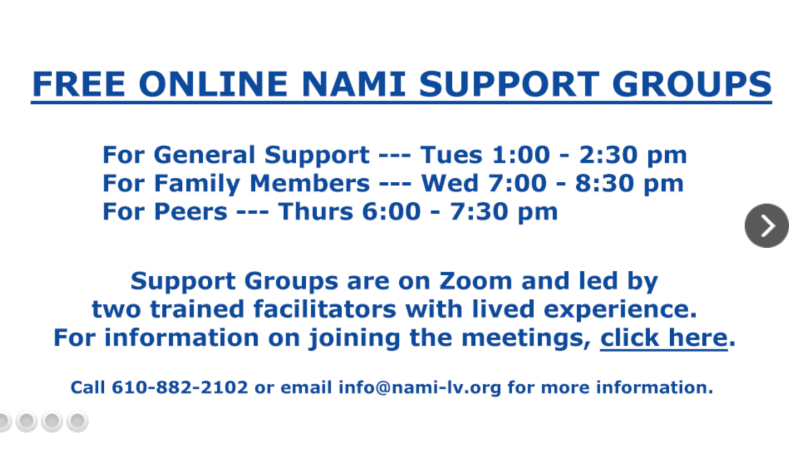
But where can we find those other people who will offer support, guidance, or just listen without judgment? This is where NAMI comes into play. There are people who are professionally trained to listen, peers who struggle with anxiety and/or depression and have learned healthy ways to cope with their illnesses. I am proud that my local NAMI affiliate offers THREE online weekly support groups for those who are struggling during these uncertain, challenging times. To find out more about these FREE weekly sessions, visit http://www.nami-lv.org/

We will get through this TOGETHER. We will come out STRONGER.

New Mental Health Initiative

So grateful to have been included in the mental health initiative panel discussion with Governor Wolf, Rep. Mike Schlossberg, and Dr. Rachel Levine held today at Muhlenberg College. Through new initiatives and candid conversation, I am hopeful that mental health will receive the same attention, care, and consideration as physical health conditions. By speaking out, eliminating barriers, and improving the quantity and quality of resources, countless lives will be saved and hope and dignity will be restored to those suffering from mental health conditions. Stand proud and speak your truth!

To read more about this event, click here

Practice Gratitude As If Your Life Depends On It–Because It Can.

It is so difficult to think positively when you are genetically wired for glass-half-empty thoughts. Whenever something good happens to me, I brace myself for the inevitable defeat, which I am convinced will follow. I’m sure I’ve created much of my own misery simply by thinking it into being. Sad, but true.

Most experts agree that it takes at least 21 days to form a new habit. Even the simplest behaviors take time and repeated practice to move them into automatic actions. Thoughts are no different. At first, it may feel forced and false to focus on the positive or practice gratitude when you really just want to go to bed and never wake up. However, that is when it is even more critical to stop the negative thought cycle and turn to gratitude. The brain cannot think two thoughts at the same time so every minute you spend on gratitude is one minute less of the “stinking thinking.” That, in itself, is a victory. Also, one expression of gratitude can lead to more positive or grateful thoughts and before you know it, you may, and most likely will, find yourself feeling a bit better.

One reason for that is the law of attraction. Good thoughts tend to attract more good thoughts and vice versa, which is why it is vital to stop a negative thought cycle and replace it with thoughts of gratitude. Practicing gratitude creates momentum in the other direction–the right direction, the direction up and out of the hole created by self doubt and hopelessness. I need to invest my time and energy in staying out of that hole and gratitude is one way to do that. It can be as simple as “I am grateful for my legs so I can walk.” Even if I don’t feel like walking or can’t muster the motivation, I can at least be grateful for the capability to walk.

It’s also important for me to find real things I am grateful for rather than constructing ones. Otherwise, it feels empty and makes me long for that missing thing even more. So I focus on people, traits, and things I actually have. For example, I have a house so I am thankful for shelter. Rather than focusing on specifics, I try to think of the general, basic needs that many do not have for which I have taken granted. It’s easy to feel like you have nothing when you scroll through a Facebook, (aka “Fakebook”) feed filled with pictures and posts of friends’ extravagant vacations, happy family photos, weight loss victories, career advancements, anniversaries, and enhanced selfies that bear little resemblance to the actual person. I have to remind myself (or my husband will) that none of that is real. I am seeing the aspects of people’s lives that they want me to see. It’s a glimpse into the best (or worst) of a person’s life and no more. Many would look at my posts and think I am doing splendidly, but I know I am not. I’m just not choosing to share the low lows. I feel them, though–all too frequently.

Perhaps the coolest thing about gratitude is that it literally rewires the brain–a far cheaper and less painful measure than more medication or, god forbid, ECT. I need all the help I can get and by focusing on all the good things I have rather than all the things I wish I had (or don’t have), I can form healthy habits and bring more positivity into my life.

For the science behind gratitude, check out this article: Gratitude Rewires Brain

Destigmatizing ECT

60 Minutes: Is Shock Therapy Making a Comeback?

Kitty Dukakis shares her personal experiences with ECT (Electro Convulsive Therapy) and gives viewers exclusive access into her own procedure. While ECT isn’t for everyone, it helps many who have not responded to medication and need more aggressive treatment. It is mostly used for MDD (Major Depressive Disorder) and is known to alleviate suicidal ideation tendencies, though it is not a panacea (cure-all) and it often takes many rounds. ECT also requires in-patient hospitalization for the first week to ensure safety and monitor response. There are many medical factors that need to be taken into account and not everyone is a candidate, but for many, including this blogger, ECT has saved lives.

On Recovery

ON RECOVERY

Recently, a friend shared the following post regarding her recovery from cancer on Facebook:

“I’ve been cancer-free for almost nine months. Some days, I can’t tell if I’m recovering from all of the treatments because it takes so long to recover. But, then I look back on the past nine months and realize that I’ve come a long way. Here’s how I know I’m getting better:

-9 Months Ago: Couldn’t do three push-ups without collapsing.

-Today: Did 20 of them.

-9 Months Ago: I could barely lift 20 pounds.

-Yesterday: I did 48kg deadlifts (I forget how to convert that number into pounds).

-9 Months Ago: Couldn’t run a mile in less than 14 minutes.

-Today: I run multiple miles in less than 12-minute miles… getting closer to 11-minute miles.

-9 Months Ago: Sometimes, I slid down the stairs because chemo made my feet numb and it was easier to slide than try to walk down the stairs.

-Today: I still hold onto the railing for dear life, but I let go on the last few stairs, now.

So, when I type it out like this, I see that there is so much to celebrate on this birthday. I’m still praying for a full recovery, but, really, I’m just grateful to be here and to know so many wonderful people”

***************************************************************************

Naturally, I was thrilled to read of her progress and all the supportive comments that followed her post. Then I thought about how far I’ve come with my own illness and I felt grateful, too.  But I wondered: what responses would I get if I posted my progress regarding my mental health condition? Would people think I was just seeking attention, exaggerating, or minimizing my friend’s struggle with cancer? Would others even read it? If they did, would they just roll their eyes and move on?  Or would they avoid me the next time they saw me in person, as if my depression might somehow infect them?

I understand that people might not know what to say to someone who struggles from depression, but saying nothing just makes a person feel more ashamed, more worthless, more invisible, and more alone.  So here is my celebration of my progress within the past 7 years

My Recovery from a Mental Health Condition:

“7 years ago, my brain broke and I was diagnosed with bipolar II and major depression. I felt like I was given a death sentence, because there is no cure for mental health conditions and I will never be “free” of it. Some days, I struggle with feelings of worthlessness, fatigue, and loss of purpose and identity; It all seems too much to bear. But, then I remember how far I’ve come and  how much I’ve learned. Here’s how I know I’m doing better:

-7 Years Ago: I was so ashamed and embarrassed, I isolated. I had no idea what was wrong with me or how to get better.  

-Today: I have shared my story publicly and strategies I use to stay well with hundreds of patients and peers and teach NAMI education courses on an ongoing basis.

-7 Years Ago: I had 30 rounds of ECT and had difficulty remembering things and communicating my thoughts.

-Today: I regained my short-term memory, my brain responds to medication, and I am able to manage side effects.

-7 Years Ago: I was unable to work and convinced I’d never work again, let alone teach.

-Today: I have several jobs that allow me to use the skills I’ve spent my whole life building (NCC, NAMI, PBS, and TUTOR DR)

-7 Years Ago: I wanted to die to stop the persistent feelings of worthlessness, hopelessness, and despair

-Today: I enjoy life and I know I have worth, purpose, and hope.

-7 Years Ago, I could barely get out of bed, get dressed, shower, and complete basic household chores

-Today: I get out of bed, complete household chores, and take care of my child on a regular basis.

-7 Years Ago: I didn’t even want to leave the house and took no pleasure in any of the things I once loved.

-Today: I direct school plays, sing in a band, perform  in community theatre, and maintain my own blog.

So, when I type it out like this, I see that there is so much to celebrate, though many will still consider me “weak,” “lazy,” “crazy,” or “over-dramatic.” I know this will be a lifelong battle and there will be relapses, but I’m grateful to be here and to have the knowledge and skills to manage my condition, educate the public, and inspire hope to others with mental health conditions.

Why is a mental health condition treated differently than a physical one? Both are life-threatening medical conditions that affect millions of people. Both require extensive treatments and medications with crippling side effects. Yet someone with cancer is accepted, acknowledged, and supported while someone with a mental health condition is questioned, avoided, shamed, and blamed. No one says to someone with cancer, “get over it,” or “you’re just too lazy to work” or “you just want sympathy” or “there are days I feel like I have cancer, too.”  That would be ridiculous. Yet, people with mental illness hear that all the time. Is a person who is battling mental health condition any less of a warrior, role model, or hero? My friend is resilient, strong, and courageous. So am I. So is anyone who fights daily to overcome any other debilitating disease.  Just because an illness cannot be seen doesn’t mean it isn’t there or is any less serious.

Until mental health conditions are given the same respect, attention, and care as physical health conditions, the stigma surrounding mental illness will continue and people will suffer in silence and shame. Precious lives will be taken that might have been saved. If you are struggling with mental illness, you are not alone. You are seen, heard, honored, and loved more than you could ever know. Fight on, brave warrior—we see you, we hear you, we honor you.